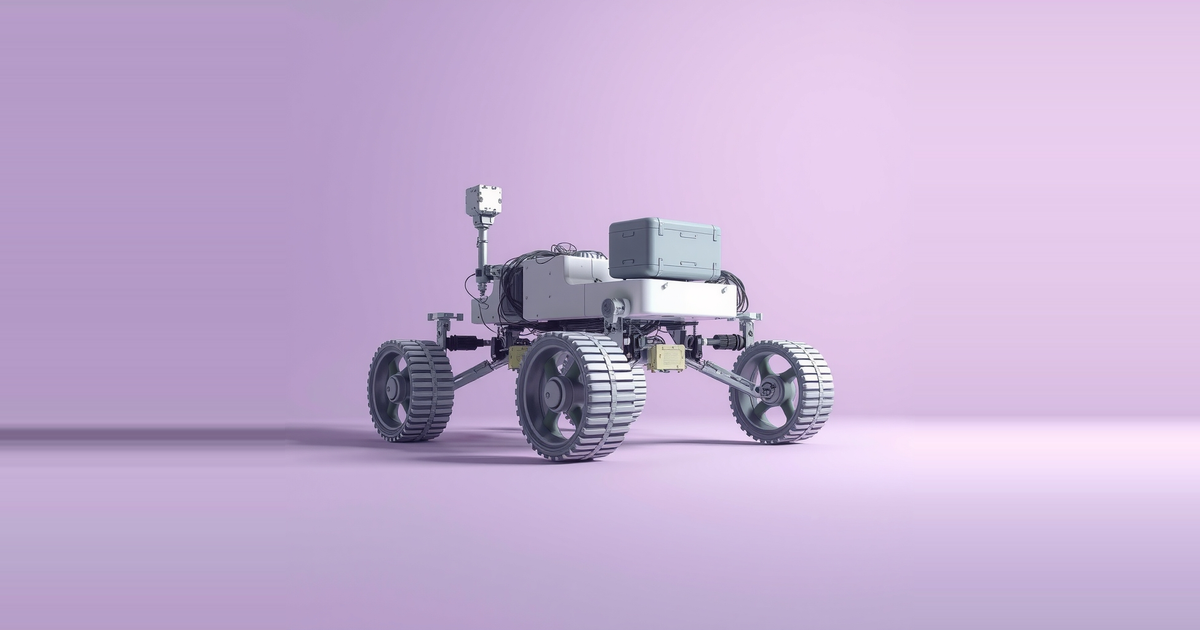
Three small NASA rovers will land on the side of the Moon facing Earth with a single instruction: work out among yourselves how to explore a patch of ground. The Cooperative Autonomous Distributed Robotic Exploration mission, known as CADRE, is a test of autonomous lunar rovers working as a team. It is planned to launch aboard NASA's IM-3 mission in late 2026.
What the CADRE rovers will do
The three rovers will spend roughly two weeks mapping terrain as a self-guided group. No operator will steer them with a joystick, and no human will approve each turn. The rovers will elect a leader among themselves and assign their own tasks. When one rover runs low on charge, they will redraw their plans as a group.
If the mission succeeds, it will be the first time NASA has operated multiple rovers beyond Earth as a single autonomous system.
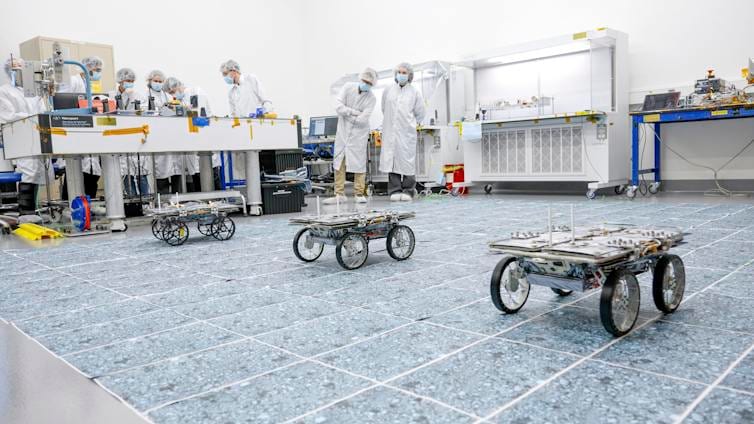
In ground testing at NASA's Jet Propulsion Laboratory in Pasadena, California, the rovers showed this coordination. Faced with unexpected obstacles, they replanned their paths as a group. When one rover's battery ran low, the whole team paused so that all three could continue together.
Why the lunar South Pole defeats remote driving
NASA is scoping future missions to the lunar South Pole, where water ice sits in craters that have not seen sunlight in billions of years. If that ice can be split chemically into propellant and breathable air, it could supply fuel depots and life support made on the Moon. Today the only demand for that ice comes from government contracts, and an operation that must be supervised from 239,000 miles (384,000 kilometers) away will not easily grow into a market.
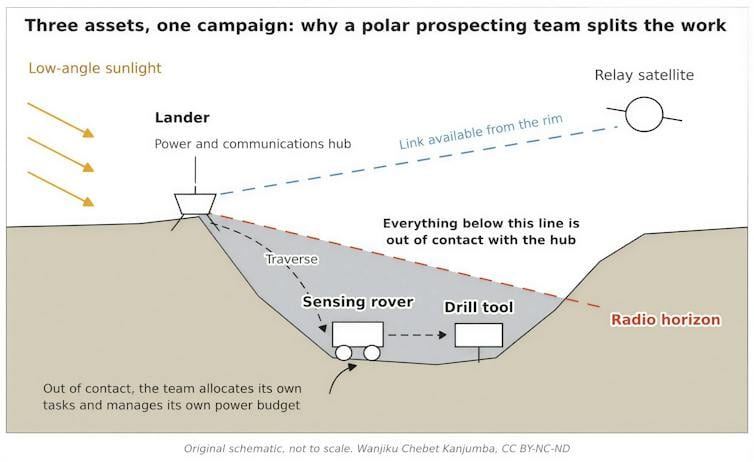
The terrain itself interrupts communication. Commands reach a rover through relay satellites, and crater rims can block the line of sight to those relays. A rover that drives into a shadowed crater may lose contact for its whole trip.
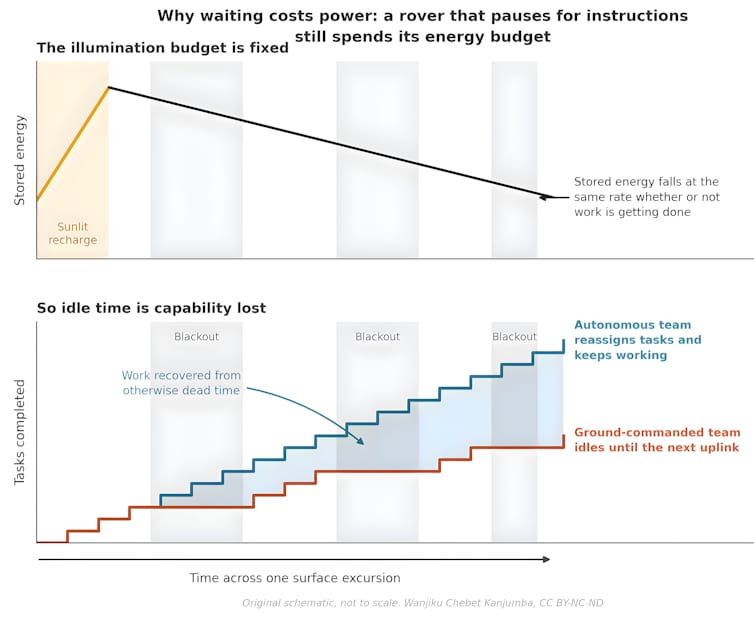
Lost contact also costs energy. A polar rover charges its battery only while the Sun is up. Night lasts about two Earth weeks, and at the poles only a few ridges stay lit for long stretches. A rover that sits idle waiting for instructions spends stored power it cannot replace until sunlight returns.
Other conditions add to the difficulty. Sunlight can swing from direct glare to total shadow as a rover descends from a lit rim, so a camera that worked at the top can go blind at the bottom. The Moon has no GPS, so rovers must build their own maps from camera and sensor data. Temperatures in permanently shadowed regions fall below minus 274 degrees Fahrenheit (minus 170 degrees Celsius).
Lunar dust is a further hazard. An electric charge lifts it off the ground, and billions of years of micrometeorite strikes have left each grain sharp and jagged. It grinds at wheel bearings, works past seals and can film over the camera lenses that navigation relies on. Keeping dust out of moving parts remains unsolved.
Why a team beats a single rover
A lone rover sent to a crater is a high-risk mission. If it gets stuck, the campaign ends, and if its instruments fail, no second machine can take the measurements. A multirobot team spreads that risk and divides the work. One rover might carry the sensors and another the drill, while a lander on a sunlit ridge serves as the power and communications hub.
During a blackout, a team that depends on Earth for commands must stop. An autonomous team reassigns tasks among its members and picks the next objective that it can reach and finish with the power it has left. Time that would have been dead becomes working time.
What remains unproven, and what CADRE can show
A South Pole campaign would need to run for months. No robot team has yet worked that hard, for that long, so far from help. Engineers are developing ways for rovers to navigate without satellite positioning and to make decisions onboard, but that software has not been tested on the surface.
China's Chang'e-7 mission was waiting at the Wenchang launch site on Hainan Island as of mid-August 2026, with liftoff expected by the end of the year. Its lander, rover and hopping probe are meant to work at the pole as a team, and the probe is built to leap into permanently shadowed craters.
The following analysis is our own reading of these facts. CADRE tests a narrower problem than the one the polar program faces. It lands on the Earth-facing side, not at the pole, and it runs for about two weeks, not months. It uses three identical-purpose machines, not a mixed fleet. A clean result would show that group decision-making works on the lunar surface. It would not show that the approach survives months of dust, cold and repeated blackouts.
The ground tests at JPL are the only evidence so far that the team behaviors work, and they covered path replanning and shared pausing for low batteries. Surface performance will be the first measure of whether those behaviors hold under real lunar lighting and communication gaps.
There is also an open question about standards. No agreed method exists for a rover built by one company to hand a task to a tool built by another, or to decide which machine works a crater floor first. CADRE's three rovers avoid that issue because they share one design. A lunar economy built on ice would likely involve several builders, so the coordination rules, not just the software inside each robot, will need to be settled.
CADRE will show whether three small rovers can reason together on the Moon. Whether a dozen machines from different builders can do the same, reliably, for years, is the question it leaves open.