A microflier weighing 150 micrograms can generate upward thrust from sound alone, using three microscopic hollow cavities printed into its polymer body. It is one of several sound-powered drones and vehicles built by the MicroBioRobotic Systems (MICROBS) Lab, whose work appears in Science Advances under the title "Acoustic resonators as wireless actuators in air for small-scale robots." Junsun Hwang is first author, and lab head Selman Sakar led the project.
How a bottle's hum becomes thrust
The design rests on Helmholtz resonance. When air moves across the opening of a cavity such as a glass bottle, the air trapped inside oscillates back and forth. At certain frequencies the oscillation grows much stronger, which produces the familiar hum of a blown bottle.
The team built hollow round and bell-shaped cavities that exploit this effect. When sound waves excite the air inside, the oscillating air leaves the cavity as a concentrated jet. The air flowing back in is more diffuse. That imbalance produces net thrust, which can push a small vehicle in one direction.
Earlier approaches used sound waves to levitate passive objects in mid-air. In those systems the sound pushes the object around. Here the object converts the sound into its own propulsive force. Sakar describes the devices as acoustic resonators tuned to harness sound at specific frequencies to produce directional thrust and controlled motion.
The cavities can be made from several materials, including common 3D-printing plastics, rubber-like polymers and glass.
Boats tuned to different frequencies
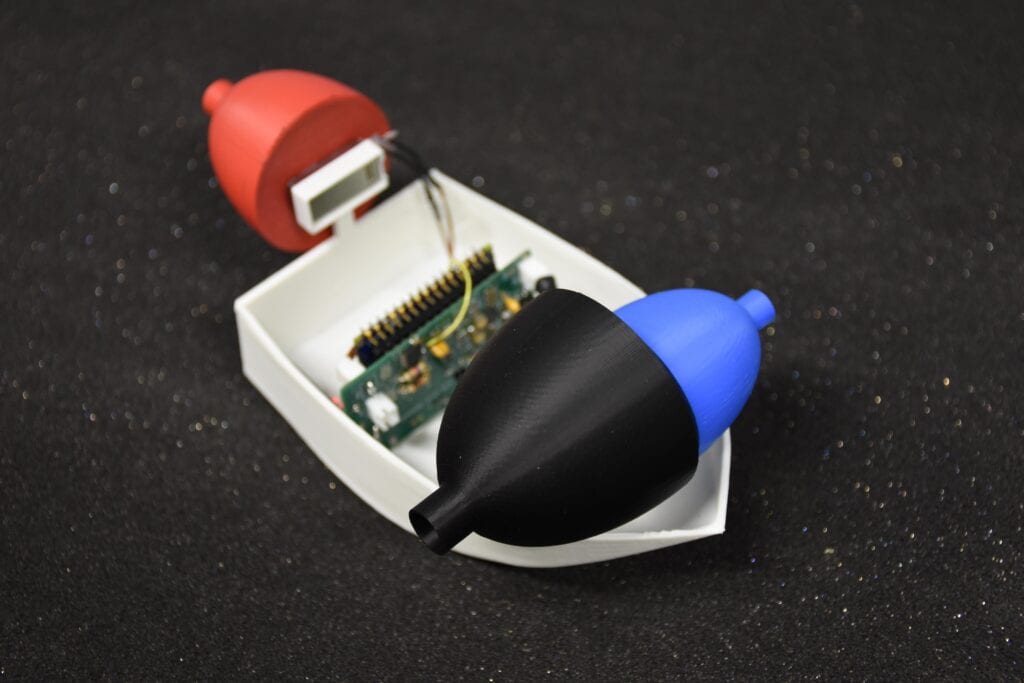
At the centimeter scale, the researchers built miniature boats carrying up to three cavities. Each cavity was tuned to a different audible frequency and positioned to push the boat in a particular direction.
A speaker supplied the sound. By changing the frequency it emitted, the team chose which cavity to activate. This let them move the boats, steer them around obstacles and program them for autonomous navigation. The steering came from the choice of frequency, not from onboard hardware.
Microfliers made with nanoprinting
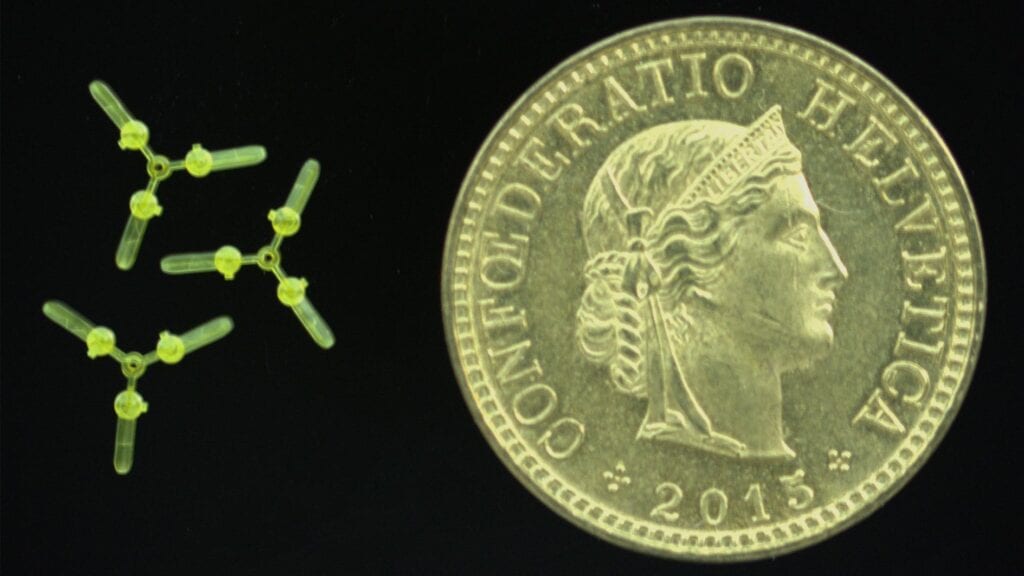
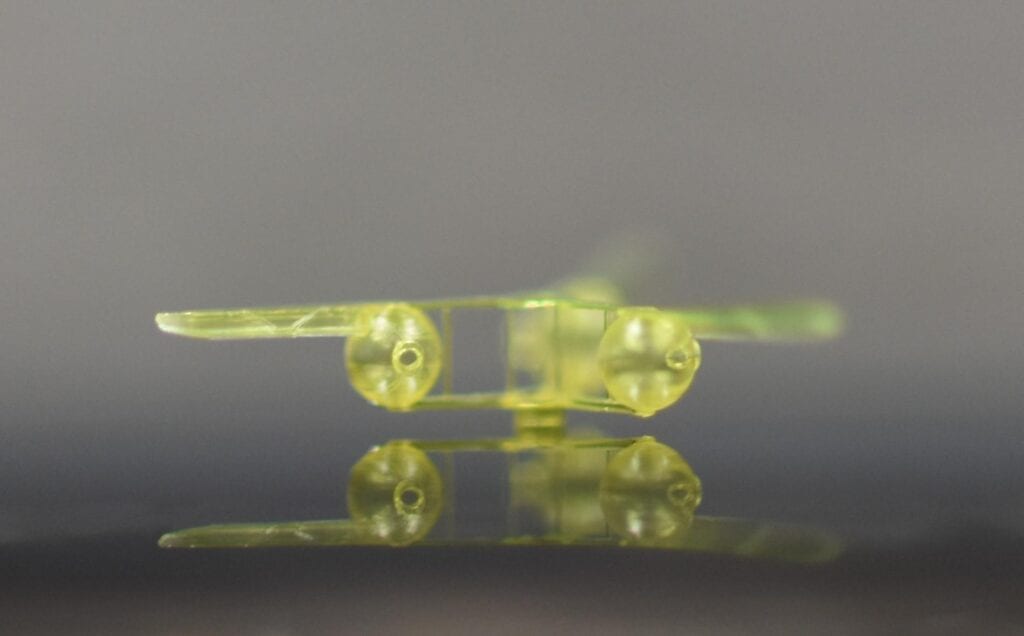
For the smaller devices, the team used a 3D nanoprinting technique to build microfliers. These are ultralight flying vehicles with three microscopic cavities integrated directly into their polymer structures. Unlike the boats, they were driven at ultrasonic frequencies that humans cannot hear.
The researchers describe two designs. The first, weighing 150 micrograms, used its cavities to produce direct upward thrust, in the manner of a rocket. The second paired the cavities with tiny blades. Those blades spun at up to 13,000 revolutions per minute and produced stable, helicopter-like aerodynamic lift.
What the design removes, and what comes next
The devices have no motors, gears or magnetic components. They depend only on hollow cavities, so they can be made very small and light with a range of 3D-printing methods. Hwang says the concept is compatible with further miniaturization, which would allow more advanced designs in robotics and aeronautics.
Sakar points to a possible next step. Several sound-responsive structures could be built into a single flexible device, each reacting to a different frequency. Specific parts of the device could then move, bend or vibrate. He says this could lead to aerodynamic robotic devices that change shape in response to sound.
Analysis: what this changes and what is unproven
The main significance is where the actuation happens. In most small robots the actuator is a separate component, such as a motor or magnet, and its mass and complexity set a floor on how small the machine can be. In these sound-powered drones the actuator is the shape of the body. Removing the motor removes that floor, which is why the 150-microgram flier is possible at all.
The frequency-addressing scheme is also notable. Each cavity responds to its own frequency, so one sound source can command several thrust directions without any onboard electronics. The boats show this directly. Three cavities, three frequencies and three directions of push were enough to steer around obstacles. That is a simple form of control, and it is wireless by construction.
The comparison with acoustic levitation is useful. Levitation techniques act on passive objects from outside, so the object has no say in how it moves. A resonator-based vehicle shapes its own response to the sound field. The reported work shows that this distinction produces controllable motion in both water-surface boats and airborne microfliers.
Several questions remain open, and the source does not answer them. It gives no figures for payload, flight duration, altitude or the sound levels needed to lift the microfliers. It does not say how far the speaker can be from the vehicle, or how precisely a microflier can be steered. The boats were steered and navigated, but the microflier results are described as thrust and lift, not as controlled flight paths. Those gaps matter, because a device that needs a nearby, powerful sound source is limited to a lab or a purpose-built environment.
The shape-changing structures Sakar describes are a stated goal, not a result. The flexible multi-resonator device has not been reported as built. The strongest claim the evidence supports is that tuned cavities can act as wireless actuators at small scales in air. Whether such sound-powered drones can leave the lab depends on the numbers the paper must still supply on power, range and control.