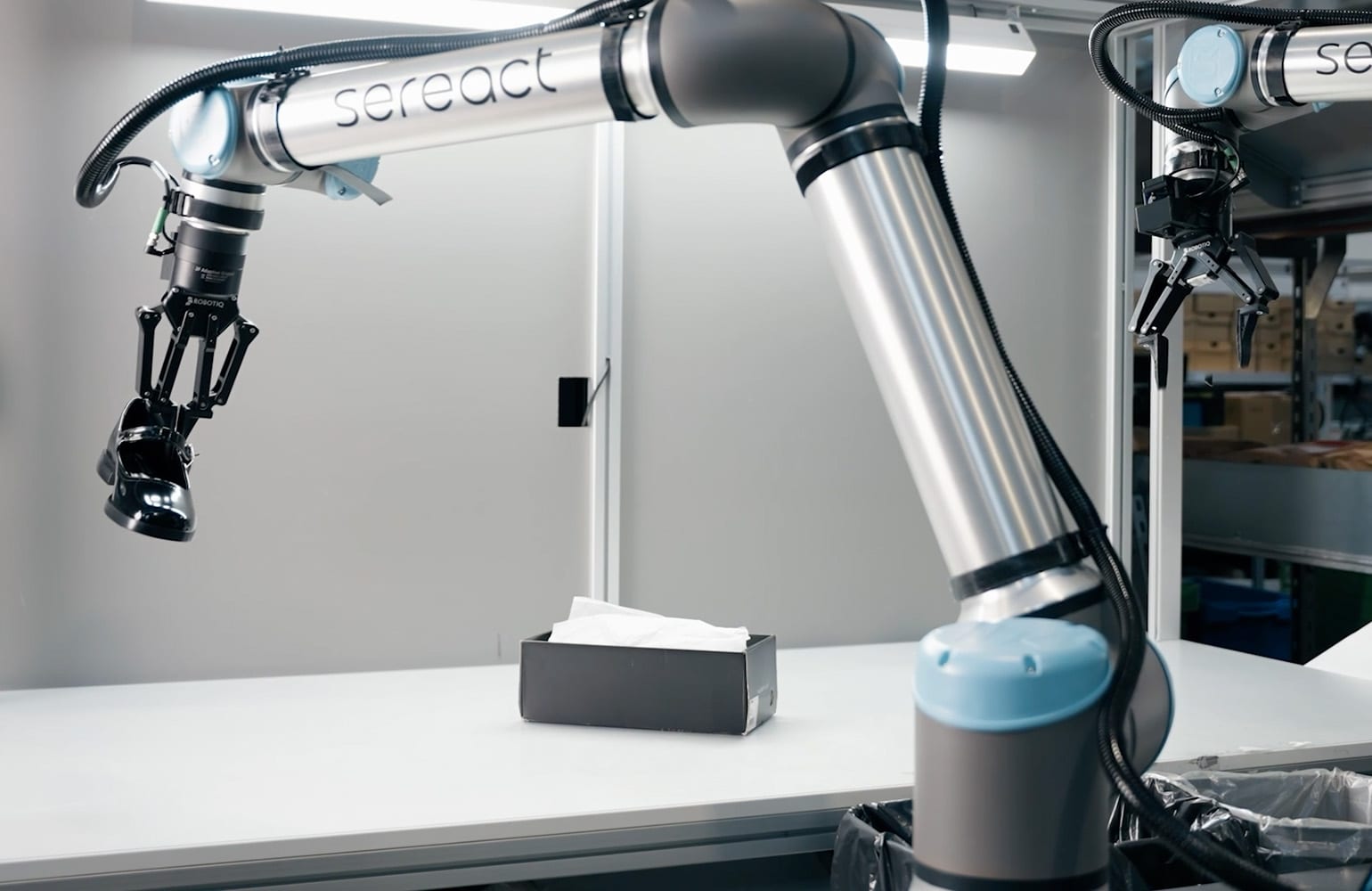
Dual-arm cells combining Sereact software with Universal Robots arms now process returned fashion items autonomously at Zalando fulfillment centers in Greven, Germany, and Świebodzin, Poland. The Sereact Universal Robots systems are deployed with CEVA Logistics, which operates for Zalando, a European technology platform for fashion and lifestyle. Zalando's sites are the first phase of a wider initiative to scale returns automation across Europe.
Teradyne Robotics, the parent company of Universal Robots and Mobile Industrial Robots, announced the partnership with Sereact at NVIDIA GTC Berlin 2026. The two companies say they have already shipped hundreds of UR robots in dual-arm systems to live customer sites across Europe.
Returns handling at Zalando
Sereact's Cortex physical AI platform drives the robot arms. At the Zalando sites it handles returned garments and other fashion goods, which the company's CEO, Dr. Ralf Gulde, describes as one of the hardest jobs in logistics. In his words, returned products almost never arrive in a robot-friendly sequence. Items differ in shape, orientation and packaging, and the mix changes continuously.
Gulde also tied the work to regulation. Rapidly reconditioning returned goods for resale, he said, helps retailers comply with European Union rules that prohibit destroying returned merchandise or sending it to landfill.
What the partnership covers
Under the agreement, Cortex runs on Universal Robots arms to automate unstructured tasks in retail, logistics and manufacturing. The companies list piece picking and sortation, order induction, machine tending, bin consolidation, kitting, packing and goods handling as target applications. Returns handling and piece picking are the two examples they lead with.
Jacob Pascual Pape, chief commercial officer of Teradyne Robotics, said the combined solution handles mixed goods, unknown items and varied packaging. He said it has moved beyond the demo or pilot stage and is running at real customer sites. He also pointed to more than 100,000 industrial deployments of Universal Robots products as evidence that the platform is proven.
Gulde described Cortex as a single production model. Returns, replenishment and kitting all run on the same model, he said, with no retraining for each new item or task, and what one robot learns benefits every robot. Sereact develops software that lets robots grasp, identify and handle objects they have never seen before.
The commercial structure matters as much as the software. Sereact expects to reach customers through Teradyne Robotics' global distribution and integrator network. To serve demand and bring the joint solution to North America, Sereact opened U.S. headquarters in Charlestown, Mass., this summer.
The NVIDIA stack behind Cortex
NVIDIA technology runs through the development and deployment pipeline. Cortex is trained in NVIDIA Isaac Sim, an open simulation framework, using NVIDIA Cosmos open world models. It is then post-trained with reinforcement learning in the NVIDIA Isaac Lab framework and benchmarked on Teradyne Robotics hardware before any model is deployed.
In operation, Cortex runs on NVIDIA Jetson Thor at the cell, where inference has to happen at line speed. NVIDIA DGX Spark handles site-level development, validation and model updates. A Sereact and Universal Robots demonstration at GTC Berlin showed this setup.
Teradyne Robotics also uses NVIDIA computing in its Universal Robots cobots and Mobile Industrial Robots platforms. The company said it is contributing SimReady OpenUSD robot assets for both UR and MiR products to the SimReady Central Library on Hugging Face. The aim is to let developers find and reuse robot models in simulation with less asset preparation.
What this means for the field
The announcement is mainly a distribution story. Sereact has software that, by its own account, generalizes across items and tasks. Teradyne Robotics has a large installed base, a partner network and a collaborative arm that integrators already know. Pairing the two gives a physical AI vendor a route to customers that a software company would otherwise have to build alone. For Teradyne, it adds a use case in unstructured handling to an arm line built for more repeatable work.
The choice of returns is a meaningful test. Returned fashion goods vary in shape, orientation and packaging, and the mix changes constantly. A system that copes with that variety is closer to the general handling that physical AI promises than one tuned to a fixed catalog. The EU rule against destroying returned goods gives retailers a compliance reason to invest, which is a firmer driver than efficiency alone.
Several points remain unproven in public. The companies give no figures for throughput, pick success rate, uptime or cost per item, so the claim that the system performs in live operations rests on their statements and on the named Zalando sites. The source does not say how many of the hundreds of shipped systems run at Zalando, or how many are in returns versus other work. The Zalando deployment is described as a first phase, and the wider European rollout is an intention rather than a result.
The single-model claim also needs outside confirmation. Running returns, replenishment and kitting on one model without per-item retraining would reduce the engineering cost of each new site. Whether that holds across different customers, product ranges and facility layouts is something only more deployments can show. The North American launch is the next place to look, since it will test the same approach with new customers and a new integrator base.
The simulation-to-deployment pipeline is worth watching for a related reason. Training in simulation, reinforcement learning post-training and benchmarking on real hardware before release is a structured way to limit risk from model updates. How well that process transfers to messy warehouse conditions will show up in the reliability numbers the companies have not yet published.