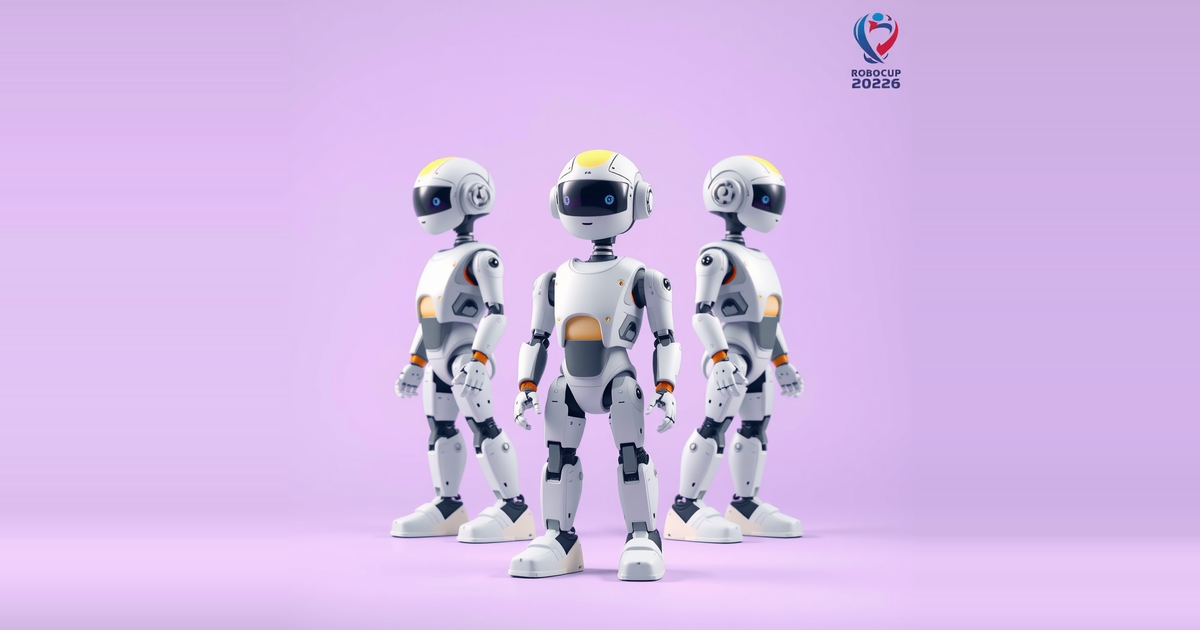
RoboCup 2026 was scheduled to run in Incheon, South Korea, from 2 to 6 July, with the soccer leagues centered primarily on humanoid robots. The event combines competitions, training sessions and a symposium, and it comes with updates to both the leagues and the competition format.
The humanoid emphasis is the most prominent of those changes. The published programme does not detail every adjustment to the format, so this report limits itself to what the schedule and league listings establish.
Dates, venue and programme
The event ran across five days, 2 July through 6 July, in Incheon. Three kinds of activity make up the programme: competitions, training sessions and a symposium. The competitions are split across several league families, each with its own schedule and rules published separately.
The symposium was set for the final day, 6 July. That places the academic part of RoboCup 2026 at the end of the week, after the competition days. Participants who compete in the earlier days could attend the closing sessions without a schedule clash, though the programme does not say how the days were arranged in practice.
The organisers described the update to the leagues and competition format as a notable moment for RoboCup. The clearest statement of what changed concerns soccer: the soccer leagues now have a primary focus on humanoid robots.
The leagues on the schedule
RoboCupSoccer lists four competitions: Humanoid, Middle size, Small size and Simulation. The humanoid league is the one the organisers single out as the main focus of the soccer programme this year. The middle size, small size and simulation competitions remain on the schedule alongside it.
RoboCupRescue has two competitions, one for physical robots and one in simulation. Rescue is a separate league family from soccer and has its own schedule and details.
RoboCup@Home and an Industrial league also appear as their own entries. The listing gives no further description of either, so their rules and formats are not covered here.
RoboCupJunior, the youth-oriented branch, runs three competitions: Soccer, Onstage and Rescue. Together with the main leagues, this gives the event a spread from simulation and field robots to performance-style and rescue tasks.

Education workshop and symposium keynotes
The programme includes WEROB, a workshop on educational robotics. It is aimed at students, mentors and educators, and its stated purpose is sharing projects, experiences and innovations. It sits alongside RoboCupJunior as a second part of the event with an education focus.
The symposium features two keynote talks. Hyun Myung will speak on spatial intelligence for autonomous robot navigation in the wild. Gentiane Venture will speak under the title From function to meaning: Making robots that understand and belong.
The two titles point in different directions. Myung's addresses how robots perceive and move through unstructured environments. Venture's addresses how robots might be understood by, and fit in with, the people around them. The programme gives no abstracts, so the content of each talk beyond its title is not known from the published listing.
What the humanoid focus means for the field
The core fact is narrow: RoboCup's soccer leagues are now primarily about humanoid robots. Its significance comes from what that implies about how the competition is organised. RoboCup has long run several soccer categories side by side, including wheeled and simulated ones. Making humanoids the primary focus means the event's most visible competition now centers on a robot form that is harder to build and control than a wheeled platform. That is a reasoned reading of the leagues' structure, not a claim about the organisers' motives, which the programme does not state.
The rest of the schedule shows the event is not narrowing overall. Rescue, home-service, industrial, junior and simulation competitions are all still listed. The shift is therefore a change of emphasis within soccer, not a change in the breadth of RoboCup.
The keynote lineup is consistent with that picture. One talk deals with navigation in unstructured settings, and the other with robots that belong among people. Both topics extend beyond a soccer pitch. That suggests the symposium is meant to connect competition work to broader questions in robotics, though two titles are thin evidence for any firm conclusion.
Several things remain unproven or unstated. The programme does not explain what specifically changed in the competition format. It does not say how the humanoid focus affects the number of teams or the rules of the other soccer leagues. It also gives no results. Whether the shift toward humanoids changes the quality of play, or the research that teams bring to it, can only be judged from the competition outcomes and the teams' own reports, none of which are part of the published schedule.
For readers following the field, the practical point is where to look. The humanoid league results will be the clearest test of the new emphasis. The WEROB workshop and RoboCupJunior show how the event keeps a pipeline running from classrooms to the main leagues. And the symposium keynotes indicate which research questions the community wants attached to the competition. Until those outputs are published, the humanoid focus is a stated priority, not yet a demonstrated change.