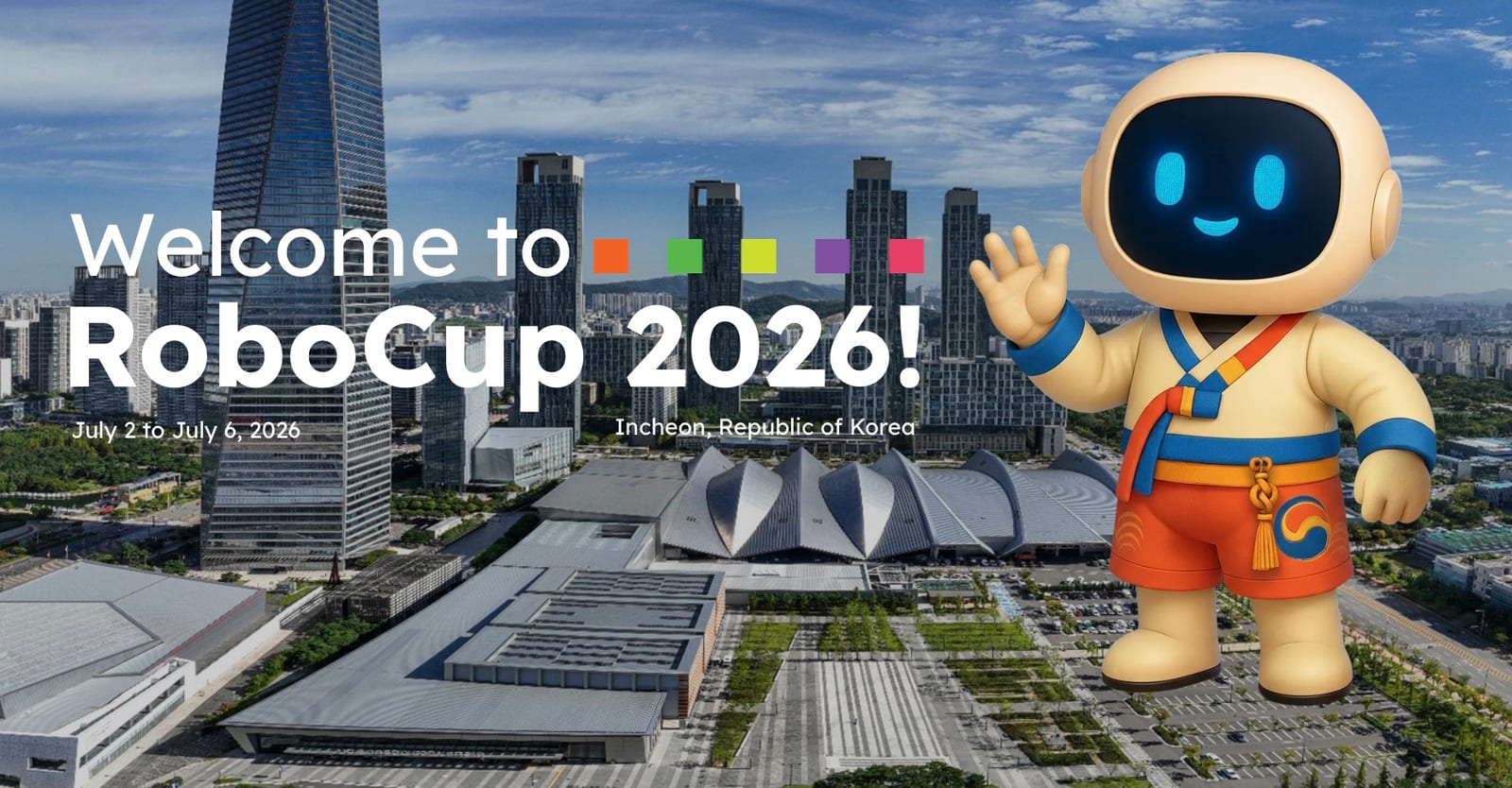
Nearly 3,000 participants from 40 countries took part in RoboCup 2026, held at the Incheon Convention Center (Songdo Convensia) in South Korea from 2 to 6 July. The week combined competitions, training sessions and a symposium, and it ended with a team from China's Tsinghua University keeping its Humanoid League title.
Five days in Incheon
The RoboCup Federation opened the event on 1 July with a first-day schedule posted for attendees. Competition ran from 2 July, and the federation said people who could not travel to Incheon could follow the matches live on YouTube and Twitch. Putting the matches online lets anyone check results independently of the teams' own accounts.
The federation put attendance at nearly 3,000 people from 40 countries in a post on 4 July. It described the shared aim as advancing robotics and artificial intelligence. The figure covers participants only. The count of teams, robots and spectators was not given.
The event was not limited to senior university teams. RoboCupJunior Egypt and a school, Colegio Leonardo Da Vinci, both shared material from the event. University and research groups also posted from Incheon, including BerlinUnited, Tech United Eindhoven, B-Human, autonOhm and Robot Club Toulon. The content of those posts was not described in detail, so what each group did on the field cannot be stated here.
Tsinghua defends the Humanoid League title
The one confirmed result is in the Humanoid League. A Tsinghua University team successfully defended its title on Sunday. No score, opponent or margin was given, and no information was provided about which robots the team used. The result shows the team won again. It does not show how close the final was.
A second result comes from High Torque Robotics, a company rather than a competition organiser. It said four Mini Pi plus teams reached the top eight and that Hamburg Bit-Bots finished in a position that is not legible in the available text. The company added that open platforms accelerate robotics. That is the company's own claim, made on 5 July. The league and the full standings were not specified.
Hardware on the field and at the edges
Two posts from 6 July show what the machines looked like in practice. One shows a Booster K1 trying to get up after falling in the middle of a football game. Recovering from a fall is a routine part of humanoid football, and the clip is a reminder that matches are still decided partly by how well robots stay upright and get back up.
The second post describes a Booster T1 fitted with an external lidar and what the author called a literal backpack. The team, tagged as Texas Robotics, said the additions were made to achieve accurate indoor localisation and navigation. The post does not say which task the T1 was performing. It also does not say whether the setup was used in a match or in a demonstration.
The K1, the T1 and the Mini Pi plus all appear in the material as platforms that teams can bring to an event. The posts do not give prices, dimensions or weights for any of them, so they cannot be compared on specifications here.
What this shows, and what it does not
The attendance figure and the live streams point to an event that is large and open to outside viewers. A count of nearly 3,000 people from 40 countries across five days is a measure of participation, not of technical progress. Participation is a useful signal for a field that depends on student teams and shared competitions, but it does not say how the robots performed.
The hardware evidence is mixed. A High Torque post links four top-eight finishes at RoboCup 2026 to a single platform family. A Booster humanoid is shown falling in a match, and another has an external lidar and a backpack added to it. Taken together, these suggest that teams are using hardware they did not build themselves and are adapting it to the task. The backpack and lidar suggest that the base robot's own sensing was not enough for the team's navigation goal. The post does not say this directly, so it is an inference and not a finding.
That distinction matters for comparison. Tsinghua's repeat win shows consistency from one team across two events. The sources give no data on how its robots compare with those of rivals, or on whether the title reflects better hardware, software or strategy. The same applies to the Mini Pi plus claim. Four teams in the top eight is a notable spread across one platform, but a company chose to report it, the placing of at least one team is missing, and the number of Mini Pi plus teams that entered is unknown. Without that number, the top-eight count cannot be read as dominance or as a modest share.
Several points remain unproven. The margin in the Humanoid League is not known. The standings behind the Hamburg Bit-Bots result are not known. How often robots such as the K1 fell, and how quickly they recovered, is not measured in the material. Whether the T1 modifications worked as intended is also not reported. These gaps are where the official results and team papers will matter, and they are what to check before drawing conclusions about which approaches are winning.
The practical reading is narrow. RoboCup 2026 confirmed a defended title, a large international turnout and a visible reliance on commercially available humanoid platforms. It did not, on this evidence, settle how far those platforms have come in balance, recovery or autonomous navigation.