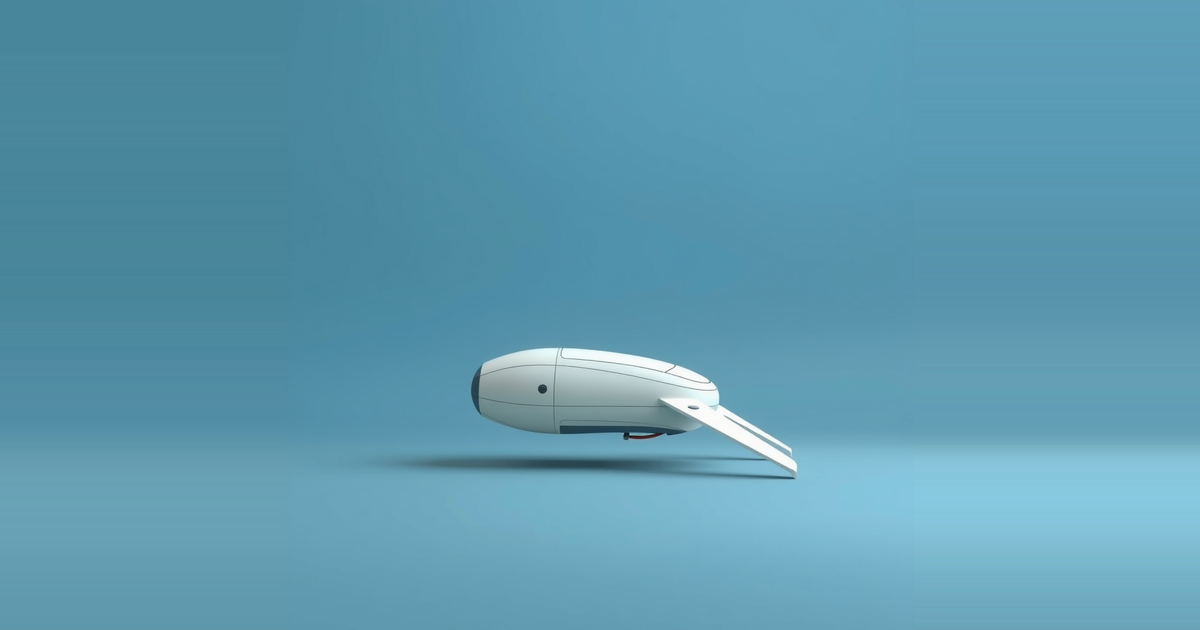
An 80 cm, 2.8 kg robot modelled on a larval zebrafish used less energy at every speed it could reach when it alternated tail bursts with passive glides than when it beat its tail continuously. The result comes from tests of ZBot, an intermittent swimming robot built by researchers at EPFL in Switzerland, Duke University in the US and Instituto Superior Tecnico in Portugal.
The finding held in both high and low Reynolds number conditions. The price was speed: the top velocity with bout-and-glide swimming was about 60% of the top velocity with continuous tail-beating.
A zebrafish scaled up 200 times
ZBot is a larval zebrafish enlarged 200 times. It copies the animal's body shape, segmented structure and center-of-mass distribution. Its tail has six segments, each driven by a servomotor, to reproduce the fish's undulation.
The head holds a central controller that acts as the robot's nervous system, high-precision cameras and real-time power meters. The power meters let the team measure energy use directly during each swimming gait. ZBot also has expandable sensor interfaces, which the team says support work on visual-motor processing and the vestibular system.
The gait under study is called bout-and-glide swimming. The animal undulates its body and tail for a short burst of propulsion, then holds a straight, streamlined posture and coasts. The behavior appears in larval zebrafish, red-nose tetra, koi carp and whales.
A neural model drives the gait
The EPFL and Duke researchers built a neurocomputational model of zebrafish circuits to control the robot. It has three main parts. Central pattern generators produce continuous rhythmic signals that create the basic swimming undulation. A bout gate collects input through a leaky integrator and starts the tail motion only when the accumulated signal reaches a fixed threshold. Simulated ventral spinal projection neurons adjust tail deflection angle, which steers the robot.
The bout gate is what produces the alternation of active bursts and passive glides. By changing tail oscillation frequency, amplitude and the gate threshold, the team reproduced several larval zebrafish gaits in ZBot: slow straight swims, routine turns and J-turns.
The team then extended the model into an end-to-end framework for the optomotor response, the fish's visually guided reaction to motion. The framework converts retinal input into motor output. It reproduced the response in ZBot and in a digital twin simulation called simZFish.
Thicker fluids test the result
Fish of different sizes swim in different flow regimes. Whales swim at high Reynolds numbers where inertia dominates. Larval zebrafish swim in an intermediate regime with stronger viscous drag. The team varied fluid viscosity to mimic animals of different sizes, mixing water with carboxymethyl cellulose sodium salt.
Three fluids were used. Plain water has a viscosity of 1 cP and a Reynolds number range of 64,000 to 160,000. A moderately viscous fluid of 213.9 cP, comparable to fruit topping syrup, gave a range of 37.4 to 448.8. A highly viscous fluid of 457.0 cP, comparable to standard makeup cleansing oil, gave a range of 1.0 to 87.5, close to the viscous flow regime.
Thicker fluid cut ZBot's travel sharply. Displacement in the most viscous fluid was only one-thirtieth of that in water. Turning was far less affected. The turning angle per bout was about 60 degrees in water and 45 degrees in the most viscous fluid.
Why the gait saves energy
A common explanation is hydrodynamic. The straight posture during a glide reduces drag, so less energy is lost. The team tested a second idea, an actuator efficiency hypothesis. It holds that bout-and-glide swimming improves the conversion of electrical energy, or chemical energy in a fish, into tail movement.
The argument rests on the efficiency curve of the actuator. Servomotors and fish muscle both follow an inverted U-shaped curve and convert energy best under moderate load. At low swimming speeds, continuous tail-beating keeps the actuators underloaded and inefficient. In a bout-and-glide cycle, the short burst keeps the motors in their efficient load range, and the glide avoids inefficient operation. The team reports that this cycling raises overall conversion efficiency.
What it means for the field
The practical lesson is a control strategy rather than a new mechanism. Underwater robots that cruise at low and medium speed could use bout-and-glide, and switch to continuous driving when they need speed for an emergency maneuver. The measured 60% speed ceiling makes that trade concrete. A vehicle that needs top speed cannot rely on the intermittent gait alone.
The actuator explanation is the more consequential claim for engineers. If part of the saving comes from keeping motors in their efficient load band, the benefit does not depend only on hull drag. It should then apply to other servo-driven robots that run at low load. The drag explanation would not carry over in the same way. The team's tests across viscosities, which showed the saving at both high and low Reynolds numbers, support the idea that the effect is not tied to one flow regime.
The work also has a second use. Because ZBot runs a model of real zebrafish circuits and reproduces real gaits, biologists can change a parameter and measure the energy cost directly. That moves some questions from observation toward testing cause and effect.
Several points remain unproven. No size of the energy saving is given, so the practical gain for a vehicle's endurance cannot yet be judged. The actuator mechanism is shown on servomotors, and the statement that fish muscle follows the same inverted U curve is argued by analogy rather than measured in fish here. The tests used one robot design in controlled fluids. Whether the same saving holds in open water, with currents, or on vehicles with different drive systems has not been shown. The proposed gait-switching scheme for underwater vehicles is a recommendation, not a tested result.