
On July 28, the US Federal Communications Commission blocked new foreign-made "advanced robotic devices" from receiving the equipment authorization required to be sold in the United States. The FCC foreign robot ban cites supply-chain vulnerabilities and cybersecurity risks. It landed in a month that also produced a spinning drone that vanishes from sight, a flying and swimming robot, and the first 11-vs-11 humanoid soccer match.
What the FCC decided
The rule covers networked humanoids, quadrupeds and other qualifying mobile robots that weigh more than 4.4 lb. Without equipment authorization, a new device cannot legally be marketed in the US. In a parallel action, the FCC also restricted foreign-produced connected power inverters.
The block is not retroactive. Existing authorized models are unaffected for now. Exemptions or conditional approvals may be available, which leaves a path open for foreign manufacturers willing to meet whatever conditions the commission sets. The details of those conditions were not part of the announcement.
Reaction in Washington and Beijing
Georg Stieler, a global robotics advisor and managing director for Asia at STM, said the measure could slow US physical AI innovation in the near term. His reasoning is that startups and researchers would be cut off from future low-cost Chinese platforms before comparable Western alternatives exist. He also said it opens opportunities for US suppliers and allied manufacturers that can localize production in the US or obtain conditional approval. "Excluding foreign products is not the same as building a competitive industrial base," he said.
John Moolenaar, a Michigan Republican who chairs the House Select Committee on China, took the opposite view. He said the FCC move "protects our country and strengthens our nation's robotics industry."
On July 30, China's Commerce Ministry threatened to "resolutely retaliate" if the United States maintains the restrictions. It urged Washington to withdraw the ban immediately. No retaliatory measure had been announced in the material available at the time of writing.
The rest of July in robotics
The month's other developments came mostly from research labs. Northwestern University researchers built a drone called Phantom Twist that spins up to 25 times per second, too fast for the human eye to resolve. To an observer it becomes a "ghostly smudge" that blends into its surroundings. The team sees uses in wildlife monitoring, environmental survey and infrastructure inspection with less visual disruption. Covert surveillance is a harder case, because the propellers are loud.
Researchers at MIT and EPFL unveiled a 250-gram robot that flies, dives, swims and launches back into the air using one pair of flexible, flapping wings. The Flapping-wing Aerial Aquatic Vehicle is inspired by diving birds such as puffins and petrels. It cruises at 6.3 metres per second in air and swims at almost one metre per second. The team envisages future versions monitoring algal blooms, coral reefs, pollutants, fisheries and coastal erosion in remote or hazardous waters.
At South Korea's KAIST, Kim Nam Gyun unveiled a robotic technology inspired by climbing ivy that lets a person put on a garment without using their hands or help from others. The vine robot turns the clothing inside out as it moves up the body. It was developed with Stanford University researchers, and the team points to chip cleanrooms and emergency services personnel as possible users.
Humanoid design drew attention for its looks. The Origin F1, shown at WAIC 2026 in Shanghai, advertised "natural eye contact" and "subtle expressions" and drew both awe and revulsion online. At K-Display 2026, LG Display took the opposite approach with a curved OLED face for humanoids that uses deliberately artificial expressions rather than trying to pass as human. A University of Tokyo team published a hierarchical Bayesian generative model that turns guidelines such as avoiding excessive realism into variables designers can manipulate and test.
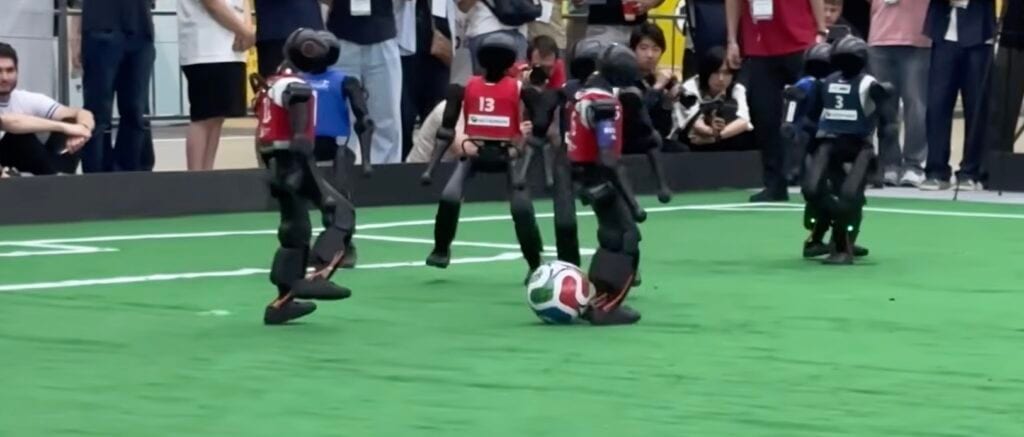
On July 5, at RoboCup 2026, B-Human from Bremen and HTWK Robots from Leipzig played the first 11-vs-11 match between full teams of full-sized humanoid robots. RoboCup's stated goal is for a fully autonomous humanoid team to beat the most recent World Cup winners under FIFA rules by the middle of the century.

Analysis: what the ban does and does not settle
The FCC foreign robot ban is notable for its mechanism. Equipment authorization is a gate every radio-emitting product passes through, so the commission can restrict a product category without a tariff or an import statute. The same tool was applied to connected power inverters, which suggests the concern is networked hardware generally, not humanoids alone. The weight threshold of 4.4 lb also means the rule reaches well beyond headline humanoids to small quadrupeds and other mobile platforms.
The practical effect depends on three unknowns. The first is how conditional approvals will work. If they are granted readily, the rule becomes a compliance cost. If they are rare, it becomes a market closure. The second is the treatment of models already authorized. Their exemption is described as holding only "for now," so buyers of current platforms cannot assume that status is permanent. The third is whether China acts on its retaliation threat, which would affect US firms that depend on Chinese components or sales.
Stieler's objection is the one the evidence supports most directly. A ban removes competitors, but it does not by itself create domestic supply. The July research items show that capable hardware is being developed in the US, Switzerland, South Korea, Japan and elsewhere. The RoboCup match was won, in the sense of being played, by two German teams. None of that amounts to a US production base for low-cost networked robots, and the rule does not claim to build one. Researchers who rely on inexpensive imported platforms are the most exposed in the near term.
Moolenaar's claim that the move strengthens the domestic industry is plausible as a direction but unproven. It requires US and allied manufacturers to fill the gap at comparable prices, and nothing in the announcement shows they can. Whether the cybersecurity rationale is borne out will also depend on what evidence of vulnerabilities, if any, the commission makes public. As of now the stated grounds are general: supply-chain vulnerabilities and cybersecurity risks.
The sensible reading is that this is the start of a process, not its conclusion. The rule is in force, the exemptions are undefined, and the response from Beijing is a threat rather than an action. Robotics companies, university labs and procurement teams will learn more from the first conditional approvals, or the first refusals, than from the original announcement.