NASA's Perseverance rover had driven 28.10 miles (45.22 kilometers) as of 11 October 2026, a total that makes it the off-world record-holder for distance driven by any vehicle on the surface of another world. The Perseverance distance record passes the 28.06 miles (45.16 kilometers) set by NASA's Opportunity rover. The margin is 0.04 miles. Perseverance reached the mark on the 2,006th Martian day, or sol, of its mission.
A record measured in years, not miles
The gap between the two rovers is small. The time each needed is not. Perseverance covered the distance in five and a half years. Opportunity took almost 15 years to cover nearly the same ground.
The Perseverance distance record is a cumulative odometry figure. It counts total distance driven, not distance from the landing site or the area surveyed. It also does not say how the two rovers divided their time between driving and stationary science. The comparison shows how much faster Perseverance has accumulated mileage. It does not show which mission has done more science.
The record came the same week that European engineers were rehearsing a different Mars problem. The European Space Agency is testing how its Rosalind Franklin rover will leave its lander. The tests use a full-size rover model and Mars-like terrain. They recreate reduced gravity, a 20-degree incline, uneven ground and obstacles beneath the ramps. The rover cannot start exploring until it gets off the lander, so the first drive is a test in itself.
Robots that join, and ducks that sing
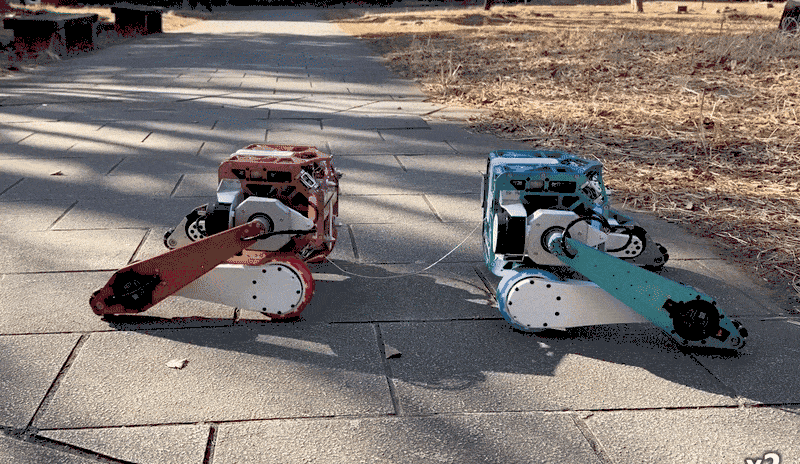
Two smaller research demonstrations this week concern machines that coordinate or physically combine. At the JSK Robotics Laboratory, two robots connected by a wire can join and form a new, single robot. The footage was shown at twice normal speed. The wire acts as the pull that brings the two machines together.
Pollen's Microducks work at the software level. Each Microduck syncs with its neighbors over Bluetooth. The group then composes a song on the fly, in harmony and in time. There is no score and no conductor. Two, three or four ducks are enough for a choir to form.
Both demonstrations are small in scale, and neither comes with performance numbers. They show two ways to make several simple machines act as one system. One does it through physical connection. The other does it through a wireless link.
Learning a task from a video
Google DeepMind described an internal test of its Gemini 4 Argon model. Researchers had the model watch a video of a human playing cornhole. Using video understanding and reasoning, the model built a simulation in MuJoCo. It then calculated the physics and whole-body control needed for Apptronik's Apollo 2 humanoid. In the real world, the robot sank seven consecutive shots.
DeepMind calls the method a Video-to-Sim-to-Real pipeline. The company says it compresses weeks of manual modeling into a few hours. That timing is the company's own figure from an internal test.
Other work this week targeted simulation and navigation. Disney Research's Kamino is a GPU-accelerated physics solver for mechanical systems with kinematic loops. Examples include parallel manipulators, planar and spatial linkages, and multi-limbed robots with coupled joints. It is designed to handle them without simplified approximations. ETH Zurich's Robotics Systems Lab presented WildOS, a system for long-range, open-vocabulary object search in unmapped outdoor environments. It combines geometric safety checks with semantic visual reasoning. It uses a vision-scored navigation graph and localizes targets beyond the horizon. Field experiments showed more efficient and robust exploration than purely geometric or purely vision-based approaches.
Robots outside the lab
DEEP Robotics sent its Lynx M20S quadruped into China's Ailao Mountains with a team of researchers on a biodiversity expedition. The robot navigated rugged terrain, scouted routes ahead, carried research equipment and captured images of wildlife in areas that are hard to reach on foot.
Boston Dynamics showed the Atlas shop floor, where parts are machined in-house and assembly and repair happen under one roof. The company says the aim is the manufacturing speed needed to build walking hardware at scale. Kawasaki Robotics also shared 1982 footage of the original UNIMATE robot from a television report, a reminder of how long industrial robots have been on factory floors.
Upcoming events include CoRL 2026 on 9–12 November in Austin and Humanoids 2026 on 6–9 December in Santa Clara, California. Panels from ICRA 2026 in Vienna are available online, including one on impact and return on investment for humanoid robots and one on sustainability in robotics.
What the Mars record does and does not show
The Perseverance distance record is the most checkable claim in this group. It rests on two published odometry totals and a stated sol count. It shows that a rover can accumulate mileage on another planet much faster than its predecessor did. It does not show that the driving was autonomous, and the figures here do not say how much of the route was planned by people. Readers should not treat it as a measure of autonomy.
The other items are harder to judge. The cornhole result is a single demonstration from an internal test. Seven consecutive shots is a clear outcome, but no success rate, number of attempts or comparison against hand-built models was given. The claim of weeks reduced to hours is plausible given the pipeline described, but it is the developer's own figure. If it holds across other tasks, it would matter, because manual modeling is a bottleneck for training humanoids in simulation. One test does not establish that.
The simulation and navigation work points the same way. Kamino targets a known weak spot, since closed kinematic loops are hard for many physics engines to handle without approximation. WildOS addresses search in places with no prior map. Both report results in their own settings. Neither has been compared here against rival systems on a shared benchmark.
One skeptical note from the same set of demonstrations applies broadly. A commentary on Sharpa's robot praised its recovery behaviors but said the robot is far slower than a human, which suggests its value so far lies mainly in novelty. That is a fair test for much of the field. A demonstration earns lasting attention when it matches human speed or reliability on a task someone will pay for. By that standard, the Mars record is the only item with a settled number. Most of the rest still need independent measurements.