Nineteen Unitree humanoid robots performed alongside 120 dancers at the opening ceremony of WorldSkills Shanghai 2026 on 22 September, in front of more than 10,000 people. Unitree describes it as the world's largest-scale performance featuring full-size general-purpose humanoid robots. The company says the show was run by a fully AI-driven autonomous robot cluster and streamed live worldwide in real time.
The claim comes from the company, and no independent count or verification accompanies it. The stated figures are still specific: 19 robots, 120 human dancers and an audience above 10,000. Those numbers make the event a useful reference point for how many Unitree humanoid robots can now be coordinated in one live show.
What Unitree showed in Shanghai
The ceremony put the robots next to human performers rather than in a separate segment. Unitree says the robot cluster performed autonomously, meaning the choreography was not driven frame by frame by operators. The company has not published details of how the robots were coordinated, how long they rehearsed, or whether any robot failed during the show. Those are the facts that would show how repeatable the performance is.
Unitree also showed a precision biomimetic dexterous hand, priced from US $6,500. The listing gives a starting price only. It does not state the number of joints, the payload, the weight or the sensing. The price still marks one concrete point: a research-grade robot hand is being sold at a figure that a university lab or a small company can plausibly budget for.
Other machines in the same week
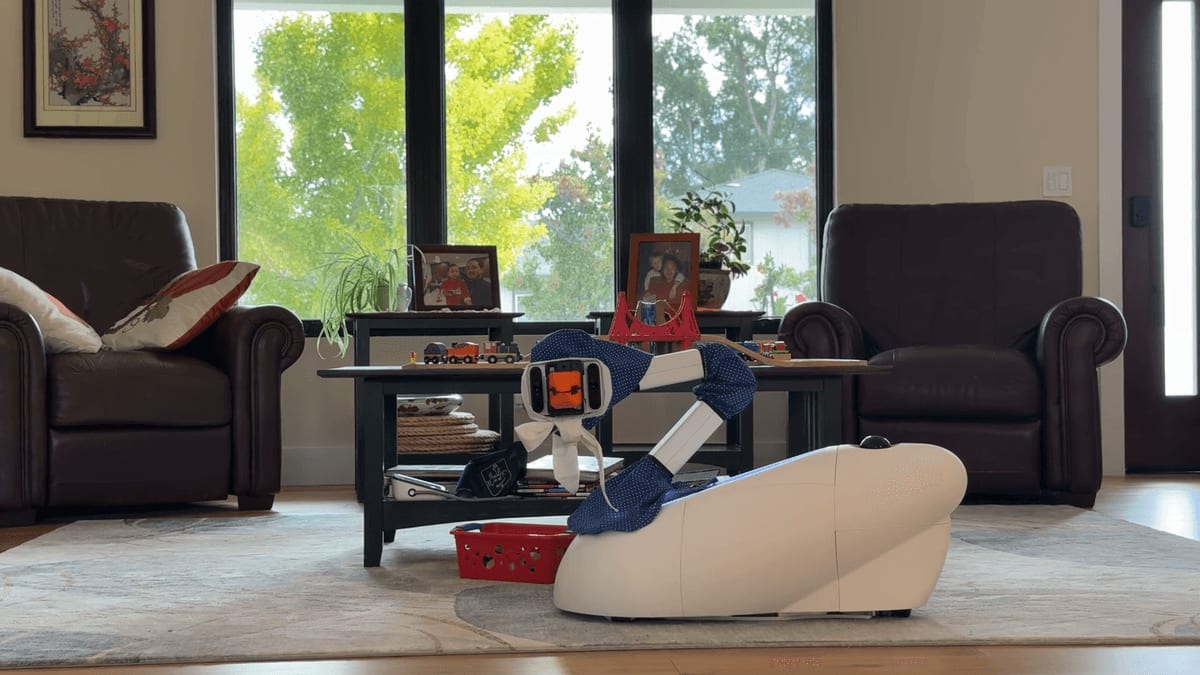
The Robot Works showed Goose, a small robot for the home. The demonstration is brief, and the company has not stated a price, a release date or a task list in the material available.
Skydio introduced the F10, a fixed-wing drone with an unusual lopsided shape. It uses a robot arm for autonomous launch and capture. The flashing LED on the drone in the demonstration video suggests the footage was sped up, probably during the capture and likely during the launch as well. The actual cycle time is therefore unclear from the video alone.
Freeform Robotics showed a group of small robots, and ETH Zurich's Robotic Systems Lab showed a tiny excavator working in flour. Neither entry comes with performance figures.
A group called ULOHA showed two robot arms working underwater. The team built custom leader-follower hardware and extended the LeRobot software to link teleoperation, demonstration collection and autonomous manipulation. In the video the arms lift objects together, pass objects between them, open a container and catch a sponge as it rises through the water. The team also studied how bubbles and the timing of action execution change the learned behavior.
The UZH Robotics and Perception Group posed a question about drone acrobatics: whether a drone can be trained by being told only whether a person likes how it flies. General Robotics Lab showed a ballbot that does not use the usual internal pendulum, and a separate robot hand. Astribot published a reel of collaborations covering long-horizon manipulation and tactile-guided actions. LimX Dynamics asked how a humanoid fits into a box.
Industrial and logistics work
Pickle Robot Company described a vision problem that looks minor. A microwave box has a picture of a microwave on its side, and that microwave has a window. To a camera, the result is a box inside a box inside a box. Parcel-handling robots have to avoid mistaking printed images for physical edges.
Boston Dynamics engineer Diane Heinle answered questions about endurance testing for the Stretch robot. Her team simulates years of wear on robot parts over a short time in the lab. Heinle also explains why bird heads appear on the parts.
Universal Robots described its g-Series as the next step in its UR Series. The company says the series connects more directly with cameras, higher-power end-of-arm tools and control systems. It says this removes external cabling and hardware, which makes deployment cleaner and faster. The company has not given prices or technical specifications in the material available.
A historical note put the current moment in context. The Honda P2, described as the first robot that could walk by itself, used motors and hydraulics in the hips, knees and ankles and weighed over 300 pounds. That was about 30 years ago.
Analysis: what the Shanghai show does and does not prove
The Shanghai performance matters because of scale and setting. Walking humanoids have been demonstrated for three decades, as the P2 shows. Running 19 full-size units in a live broadcast beside 120 people is a different test. Every unit has to stay upright, keep timing and avoid collisions, and a single fall is visible to the whole audience. If the show went as described, it shows that Unitree can build and maintain a fleet of this size and keep the machines coordinated for the length of a ceremony.
It does not show that these robots can do useful work. A choreographed routine is a fixed sequence in a controlled space, and the stage is built to suit the robots. Industrial examples in the same group of demonstrations point to a harder problem. Pickle's box-in-a-box vision task and the endurance testing of Stretch parts both address variation and wear, which a rehearsed dance does not test. Nothing in Unitree's description covers payload, battery life, recovery from a fall or behavior with an unplanned obstacle.
The claim of full autonomy also needs scrutiny. Unitree says the cluster was fully AI-driven and autonomous, but it has not said what that covers. A group can follow preloaded motion plans with onboard balance control and still be called autonomous. It is a different thing for each robot to perceive and respond to its surroundings. Until the company publishes details, the claim describes the show and not a capability that can be reused.
The dexterous hand adds a second reference point. At US $6,500 and up, it sets a price that competing hand makers will be compared against. Because specifications are missing, buyers cannot yet judge whether the price is low for what it delivers. The ULOHA and General Robotics Lab entries show that research groups are working on manipulation under hard conditions, such as underwater use, and that hardware like this is where the work depends on component cost.
Several things remain unproven: the repeatability of the Shanghai performance, the meaning of its autonomy claim, the real cycle time of the Skydio F10 launch and capture, and any commercial terms for Goose. Upcoming events give the next chance to see independent results. IROS 2026 runs 27 September to 1 October in Pittsburgh, CoRL 2026 runs 9 to 12 November in Austin, Texas, and Humanoids 2026 runs 6 to 9 December in Santa Clara, California.