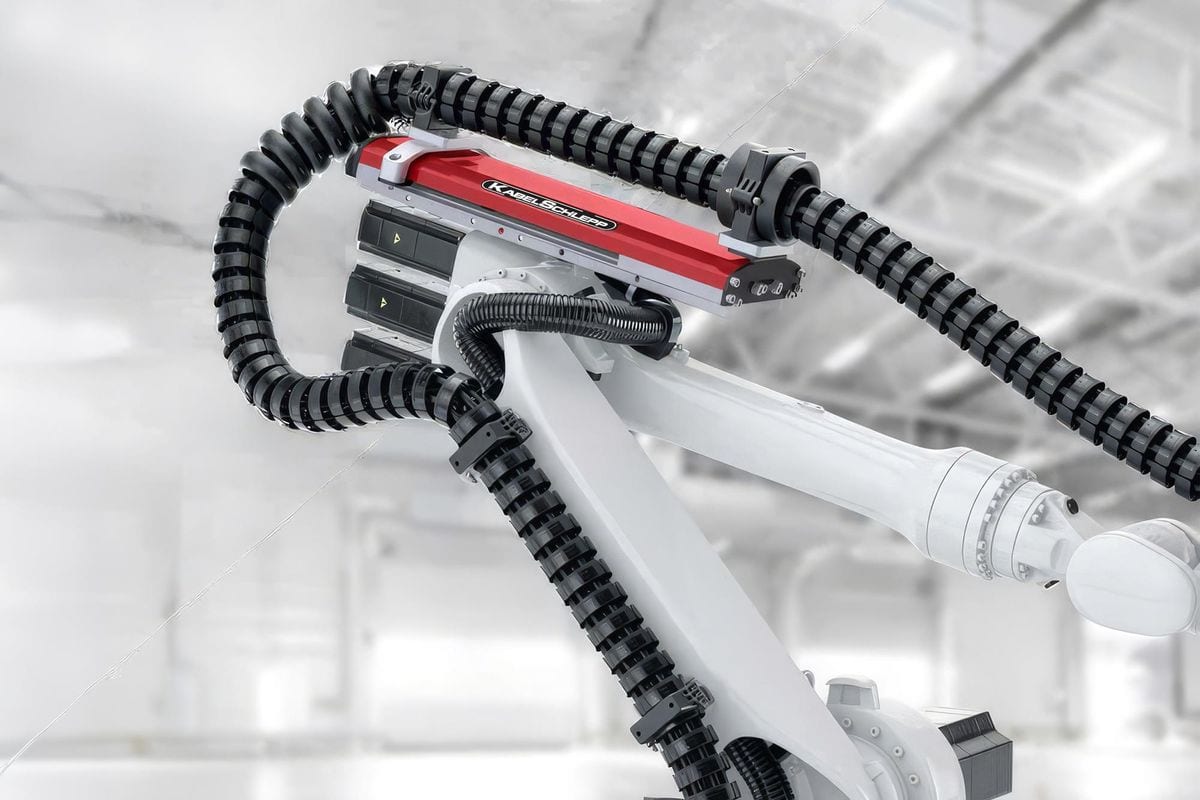
Tsubaki Kabelschlepp builds a central steel cable into every link of its Robotrax robot cable carrier, so that pulling forces from fast arm movement load the steel rather than the conductors and hoses inside. The company says the cable handles the primary tensile load when a robot changes direction or accelerates at up to 10 g.
The system targets six-axis articulated robots. As these arms swivel, rotate and extend, the electrical cables, fiber optics and pneumatic hoses that serve them are exposed to torsional twist, rapid acceleration and repeated contact with machine structures. Tsubaki Kabelschlepp lists premature conductor fatigue, insulation breakdown and unplanned production stops as the usual results.
A steel cable carries the load
In conventional cable carriers, the stress of operational movement passes directly to the lines inside. Robotrax is designed to route that stress elsewhere. A steel cable runs through the core of each chain link and absorbs the main tensile forces. The manufacturer says this isolates the electrical and fluid lines from pulling forces and extends cable service life.
Tension in the system can be adjusted with an integrated clamping piece. Tsubaki Kabelschlepp says this lets mechanics calibrate the carrier and keep its mechanical support consistent over long operating cycles. A separate tension piece locks the chain links.
Link geometry and cable routing
The links are open, single-piece plastic parts with spherical snap-on connections on both sides. That geometry lets the carrier flex across three axes. Radial rotation reaches up to ±450 degrees per meter, depending on model size.
Each link can contain up to three chambers. The company says this separation keeps heavy power lines, sensitive data channels and fluid hoses from interfering with one another or abrading each other. In the standard sizes, R040 through R100, technicians press cables into the open carrier without tools. The company says this reduces installation and maintenance time and makes it easy to inspect every cable.
The larger R140X configuration uses swiveling crossbars with snap locks. It also takes vertical and horizontal dividers, so the interior can be partitioned to suit the cable set. A quick-release bracket handles fixing and continuation of the carrier, and LineFix clamps provide strain relief.
Pull Back Unit and protectors
Large work envelopes and fast trajectories can leave a loose carrier loop free to swing into the robot body. Tsubaki Kabelschlepp addresses this with the Pull Back Unit, or PBU, an active retraction mechanism that keeps tension on the carrier through the whole motion cycle. By preventing excess slack, the unit reduces the chance of collisions along complex movement paths.
The retraction element needs no maintenance, according to the company. Standard mounting configurations exist for KUKA, ABB and FANUC robots.
Protectors can also be retrofitted to individual chain links. They limit the minimum bending radius so the carrier is not over-flexed, and they shield the chain body from hard impacts and abrasion. When a protector wears out, technicians replace that module instead of the whole carrier assembly.
Accessories for harsh cells
Tsubaki Kabelschlepp positions Robotrax for applications from automotive welding cells to high-speed machining centers and offers accessories for those conditions. Heat shields made of aluminum-coated textile fiber protect against radiated heat, hot weld spatter and flying sparks. Coated polyester sleeves guard lines against cutting fluids, hydraulic oils, paint overspray and abrasive dust. LineFix multi-layer clamps anchor the cables at both ends to prevent axial displacement during intense motion.
Analysis: what this means and what is unproven
Cable management is rarely the headline in a robot cell, but it is a recurring cause of stoppages, because a failed dynamic cable halts a line as surely as a failed drive. The design logic here is sound and easy to follow: separate the tension path from the signal and fluid path, so the part built to be loaded takes the load. Routing tensile force through a steel element is a long-established approach in engineering generally, and applying it inside each link of a three-dimensional robot cable carrier is a reasonable answer to the multi-axis twisting that planar carriers were not built for.
The pairing with the PBU is the more practical point for integrators. Carrier collisions with the robot body are a separate failure mode from conductor fatigue, and the company treats them separately, with active retraction for slack and retrofittable protectors for contact wear. Mounting options for KUKA, ABB and FANUC platforms mean the retraction unit can be fitted to the robots most commonly found in welding and machining cells.
The claims themselves need caution. The material describes service life as extended and uptime as maximized, but it gives no cycle counts, no service-life figures and no comparison against other carriers or against conventional cable management. The 10 g acceleration figure and the ±450 degrees per meter rotation figure are the manufacturer's specifications, and the rotation figure varies by model size without a breakdown by size. No customer deployment data or independent testing is cited.
Buyers should also weigh trade-offs the material does not quantify. A steel-cored, multi-chamber system with a retraction unit adds components and cost compared with a simple carrier, and the price of the system is not stated. Whether the reduction in unplanned downtime outweighs that cost will depend on cell duty cycle, cable type and how often collisions occur today. Until service-life data from running cells is published, the design reads as a well-reasoned engineering approach with performance claims that remain the vendor's own.