Digit 5 puts down its load and lowers itself into a seated position when a person comes near. Agility Robotics designed the behavior so that the robot cannot fall on anyone. The company announced the Digit 5 humanoid on September 15, 2026, and says it can work near people without safety barriers.
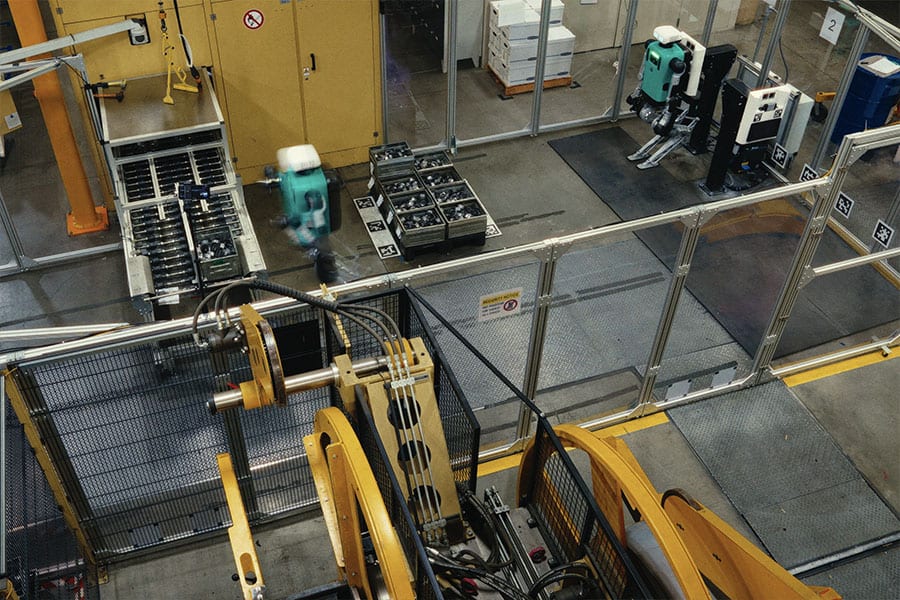
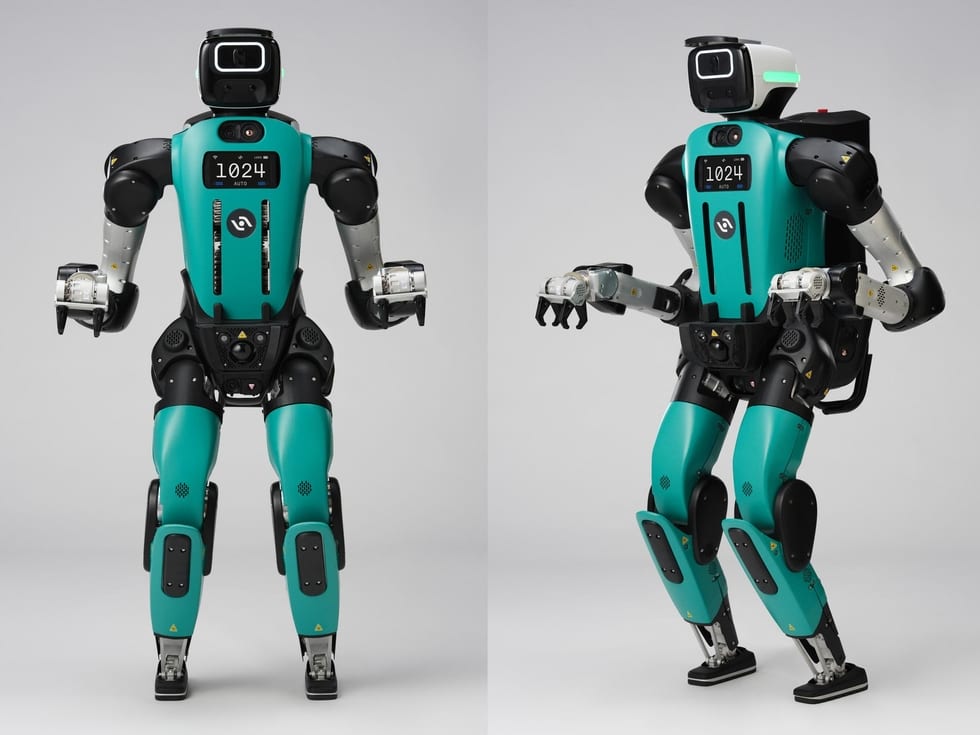
Agility has not yet deployed Digit 5 in factories. The hardware exists, and the company has released photographs of it.
What Digit 5 is built to do
Digit 5 stands 1.8 meters tall and weighs 129 kilograms. It can lift 23 kilograms to a height of 2.1 meters and can operate for more than 20 hours a day. Agility chose those figures to balance three requirements that work against one another: enough power to do useful work, enough safety to share space with people, and enough battery life to limit time on a charger.
The size and weight reflect that trade-off. A robot with more lifting power needs heavier actuators and a larger battery, and a heavier robot is harder to make safe around people. Agility has settled on a machine that favors function over appearance.
Safety by not falling
Humanoid makers have said little about what happens when a bipedal robot loses balance near a person. Agility's answer is to remove the possibility of a fall onto anyone. Its announcement describes Digit 5 as autonomously avoiding, stopping, or assuming a seated position.
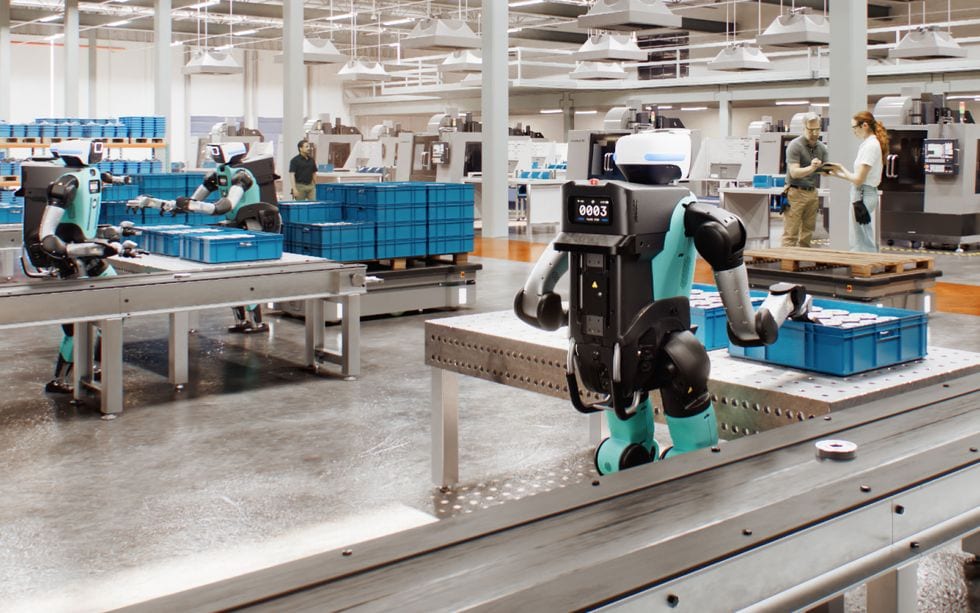
In practice, the sequence is simple. As a person approaches, Digit sets down whatever it is carrying. If necessary, it then settles into a stable seat on the ground before the person gets close. A rendering released with the announcement shows several Digit 5 units working in a factory with people nearby and no barriers between them.
The approach is not graceful, and it means the robot stops working when someone walks up to it. It does give Agility a concrete safety claim that can be tested: a robot that is already seated cannot topple onto a bystander.
New legs, and what the robot costs
Digit 5 also changes the leg design. Agility's earlier robots, Cassie and the Digit series, used bird-like legs that bend backward. Agility co-founder Jonathan Hurst explained in a 2019 article that this configuration came from analysis of animal locomotion physics, not from an attempt to copy any animal. Bird-style legs suit dynamic motion. Human-style legs suit squatting and lifting, which is the work Digit 5 is meant to do.
Agility's June SEC filing, submitted ahead of its plan to go public by the end of 2026, supplies cost figures that were not part of the product announcement. At launch, the bill of materials for Digit 5 is likely to fall between $150,000 and $200,000. That covers the parts only, not the cost of assembling a robot. Agility expects that, with near-term optimization and production of 10,000 units per year, the figure would fall below $50,000 per robot.
The filing also sketches a business model. Agility estimates that customers would pay for Digit 5 as a service at roughly $8,500 per month. Using 20 hours of work per day and a total employer cost of $30.50 per hour for a human worker, the filing suggests an employer could save about $100,000 per year per robot. The filing calls these "rounded estimates" that are "purely illustrative."
Orders, financing and timing
As of May 2026, Agility reported more than $300 million in multi-year customer orders for Digit 5. It also reported a sales pipeline across manufacturing, warehousing, and logistics. At the cost levels above, those orders amount to comfortably fewer than 1,000 robots, about one-tenth of the full capacity of Agility's RoboFab factory in Oregon.
Scaling beyond that depends on financing. Agility plans to become a public company through a merger with a special purpose acquisition company, which is expected to close within the next few months. It hopes to raise more than $620 million, mainly to scale Digit 5 production and deliver units to customers. Customers in the European Union and United Kingdom should be able to buy the robot in 2027.
Analysis: what this changes and what is unproven
The significance of the Digit 5 humanoid lies less in any single specification than in where Agility has chosen to put its effort. Many humanoid programs show off agility and speed. Agility is treating safe operation around people as a design constraint from the start, and it is accepting a visible cost in robot behavior to meet it. A robot that sits down when approached trades throughput for a safety argument that a customer's safety team can follow.
That trade-off has limits that the available facts do not resolve. A robot that stops whenever someone approaches may lose working time in busy facilities where people pass often. The 20-hour operating figure describes battery life, not productive hours, and nothing stated shows how often the seated behavior would interrupt a shift. Agility has also not said whether the barrier-free claim has been reviewed by an outside safety body.
The economics carry similar uncertainty. The cost reductions depend on reaching 10,000 units per year, while current orders point to fewer than 1,000 robots. The $100,000 annual savings figure assumes Digit 5 can replace human labor with little friction, and the filing itself labels its numbers as illustrative. Several factors that would move them, such as component prices and customer integration costs, are outside Agility's control.
Compared with other commercial humanoids, Digit 5 stands out for pairing a payload of 23 kilograms with a stated approach to working near people. Whether that approach holds up in real facilities will become clear only once robots are deployed. Until then, Digit 5 is a credible hardware design with a specific safety claim, and its commercial case still depends on a financing event and on factory results that do not yet exist.