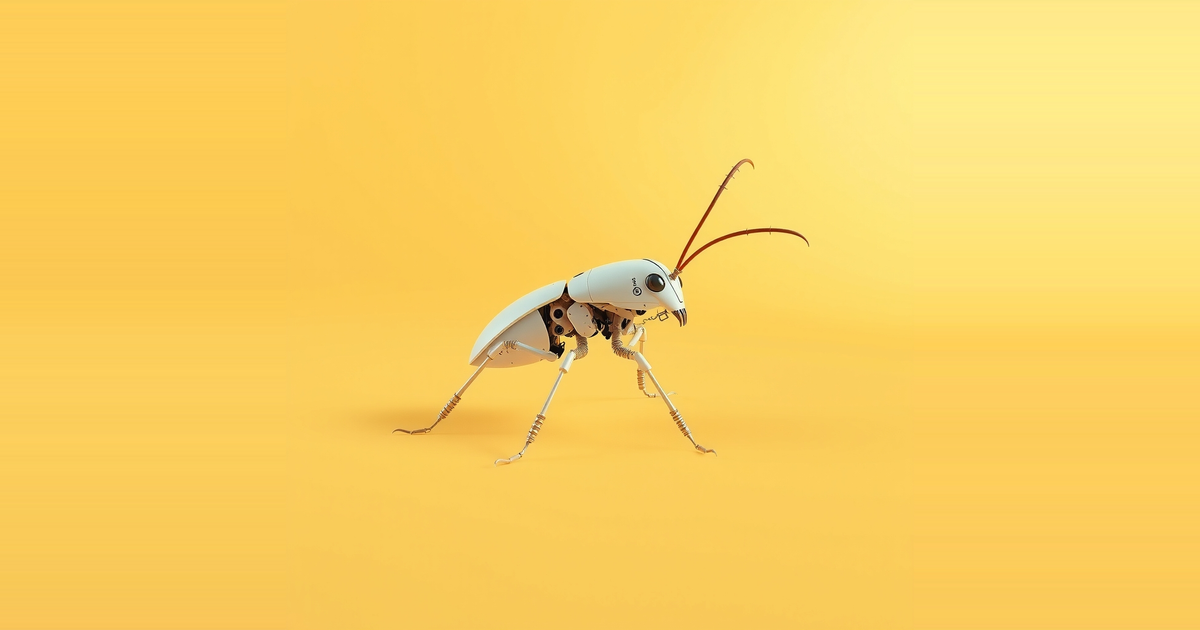
Cyborg cockroaches steered by a handheld gaming controller crossed a 2.5-meter course in all 25 trials and then fired a spring-loaded syringe at a silicone target, hitting it 72 percent of the time. The University of Queensland's Biorobotics Lab in Brisbane, Australia, built the prototypes, which it calls Paraborgs, short for paramedic cyborgs. The lab published the results in the journal Advanced Science.
How the Paraborgs are built
The team used Australian giant burrowing cockroaches, Macropanesthia rhinoceros. At roughly 40 grams, the species is the heaviest roach in the world. The researchers needed an insect that could carry more than half its own weight. A large body is also easier to operate on when implanting a cybernetic interface.
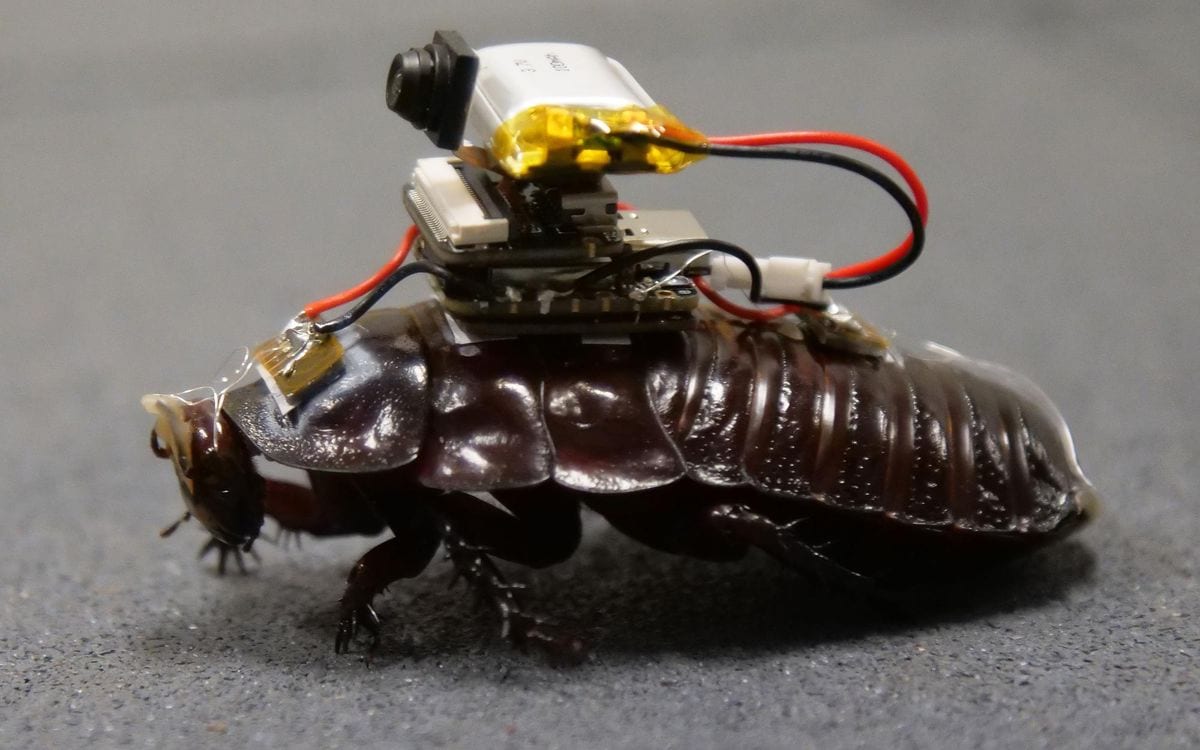
Each roach carries lightweight electronics. Electrodes are implanted in the antennae and in the cerci, the small tail-like appendages at the rear of the body. An operator sends signals wirelessly from a handheld gaming controller. The signals can turn the insect left or right, push it forward, or stop it.
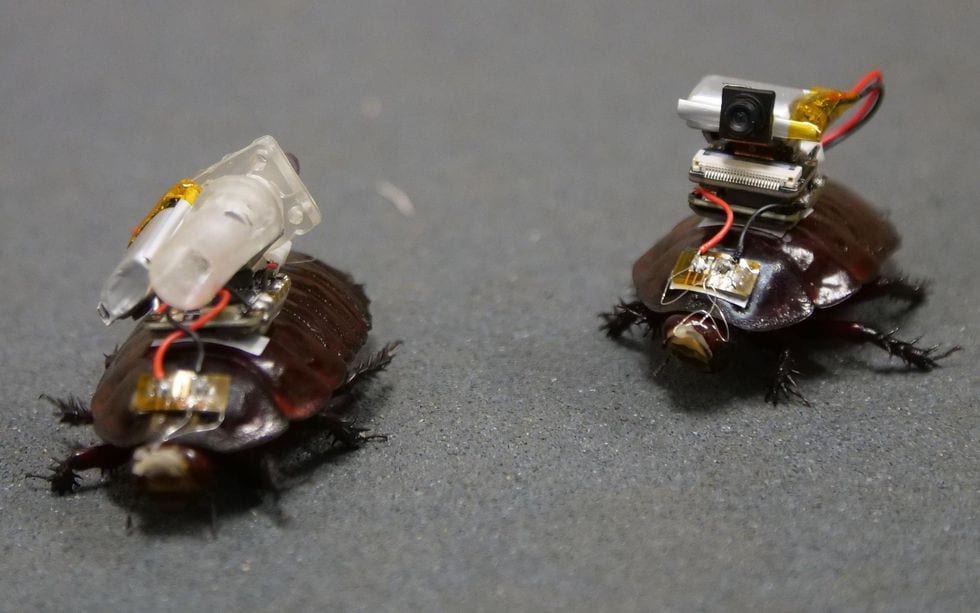
The payload is one of two things: a wireless camera or a remote-controlled injector. The injector uses a spring to launch a drug-filled syringe at a nearby target. A chemical reaction inside the syringe then produces a puff of carbon dioxide. The gas builds pressure in the syringe and pushes the drug out.
The team chose not to put a camera and an injector on the same animal. The combined weight and bulk could impair mobility on complex terrain, and two sets of electronics would draw more power and shorten operating time. The researchers instead describe teams of Paraborgs in which some insects carry cameras and others carry injectors with potentially lifesaving medication.
Why a living insect
T. Thang Vo-Doan, director of the Biorobotics Lab, says cyborg insects offer a shortcut around some of the hardest problems in robotics. An insect-size machine that moves reliably through rubble, climbs irregular surfaces, recovers from falls, carries its own power and still has room for sensors is extraordinarily difficult to build, he says. A living insect already has most of that mobility. The researchers add an electronic interface and use what the animal can already do.
Scientists have previously steered cyborg beetles and moths. That work largely treated the insects as passive sensor platforms and focused on controlling their movement. The Queensland project grew out of a 2023 conversation between Vo-Doan and fellow researcher Thanh Nho Do, held shortly before that year's IEEE International Conference on Robotics and Automation. They were discussing search-and-rescue insects and asked what happens after an insect finds a trapped victim, and whether it could provide some help while rescuers are still on their way.
What the tests showed
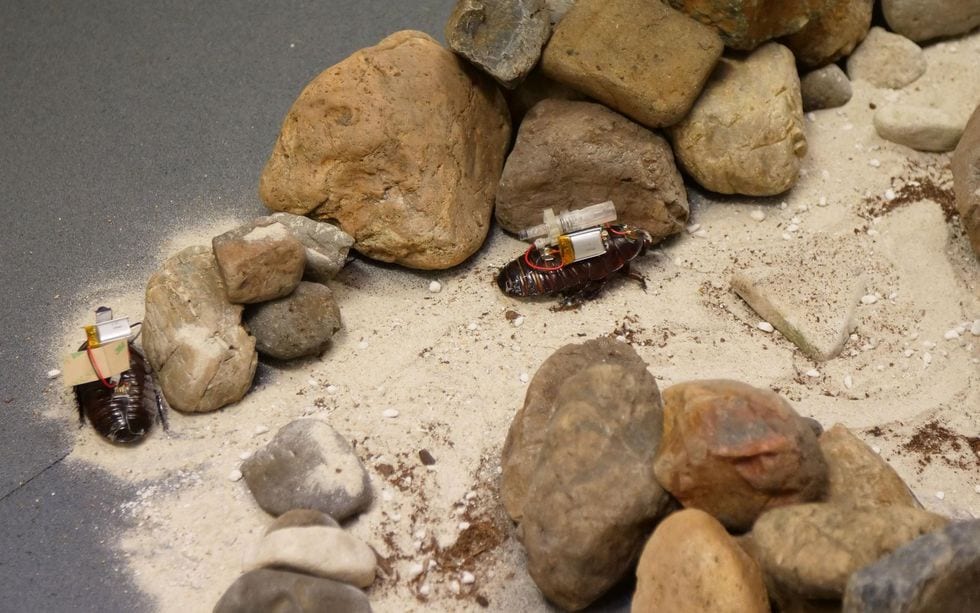
In the proof-of-concept tests, the Paraborgs were navigated over a 2.5-meter course past three checkpoints. At the end, the injector launched its needle at an 8-by-10-centimeter silicone target. Across 25 trials, the roaches completed the course every time. They injected the target in 72 percent of the trials.
The roaches remain alive and keep their own locomotion skills. Vo-Doan says the operators are not piloting them like wheeled robots. Electrical stimulation influences direction, but the insect still generates and controls much of its own movement.
What the team says is unresolved
Vo-Doan is direct about the limits. He says the team is not suggesting this is a medical device ready to be used on people today. Real disaster sites contain unstable debris, narrow gaps and communication difficulties, and the team still has to learn how the insect, electronics and injector perform under those conditions. He lists open questions on drug choice and dosage, sterility, needle safety, reliability and regulation.
The practical engineering list is also long. The team wants to compensate for the movements of victims, establish reliable wireless communication inside collapsed structures, and guide the insects through rubble and dust. Autonomy will matter more as the team tries to run several cyborgs at once. The Paraborgs will also need better onboard systems to track their own position and actions, so researchers can tell when an insect has strayed from its course or become less responsive.
The researchers also expect that a trapped person may be startled to see a cyborg insect approach. Vo-Doan suggests flashing lights, recognizable emergency markings, or a small speaker saying that help is on the way.
Analysis: what this does and does not establish
The result matters for the field because of what the payload changes. Earlier cyborg insects mainly carried sensors, so the best outcome was finding someone. An injector gives the platform a way to act, which is the step the Queensland team set out to test. The split between camera carriers and injector carriers also follows from a hard constraint: a 40-gram animal has limited capacity, and the team traded capability per insect for a division of labor across a group.
The numbers need careful reading. A 100 percent course completion rate shows the steering method worked reliably in a short, controlled run. A 72 percent injection rate means roughly one in four attempts did not succeed. The target was a silicone pad of fixed size, and the source describes no tests on moving subjects, on real tissue, or inside rubble. For a drug delivery system, a miss is a more serious failure than it would be for a camera, and the team itself lists needle safety and dosage as open questions.
Compared with fully artificial robots, the approach trades control for capability. A living roach brings mobility that small machines struggle to match. But Vo-Doan acknowledges the animal keeps much of the control, so the system is less predictable than a wheeled robot. The planned onboard position and activity monitoring is aimed at that weakness, and it has not yet been shown.
What remains unproven is nearly everything between this bench result and a disaster site: communications through collapsed structures, navigation through dust and debris, working with several insects at once, and regulatory approval for injecting people. Vo-Doan also frames the work as feeding into fully artificial designs, which suggests the cockroach is a stopgap as much as an end product. Until the team reports tests under realistic conditions, cyborg cockroaches are best viewed as a demonstration that a living carrier can be steered to a target and trigger an injection.