Curiosity rover operations at NASA's Jet Propulsion Laboratory in Pasadena, California, begin each day with a shift that starts at 8:15 a.m. and gives a few dozen engineers and scientists just three hours to decide what the rover does next. Ashwin Vasavada, the mission's project scientist, describes the routine as a rush that his team has repeated more than a thousand times since the rover landed in 2012.
A seven-hour window
The cycle starts on Mars. Overnight on Earth, Curiosity finishes its day of work and sends images and measurements to an orbiter passing overhead. The orbiter relays the data to Earth, where it sits on servers at JPL and at partner institutions around the world.
Once the shift begins, the team has three hours to check the rover's health, analyze the new science data and agree on the next set of activities. A further four hours go to turning that plan into rover commands for the following day. Those commands must be safe and must fit within the rover's available time and energy. Hundreds of commands are then sent through NASA's Deep Space Network. The deadline is set by the Martian day: the Sun rises at the rover's location, and Curiosity then waits for its next instructions.
Vasavada's job is to make sure the output of that rush advances the mission's science objectives and keeps the project on track to deliver what the team promised NASA and the public.
What the rover is there to find
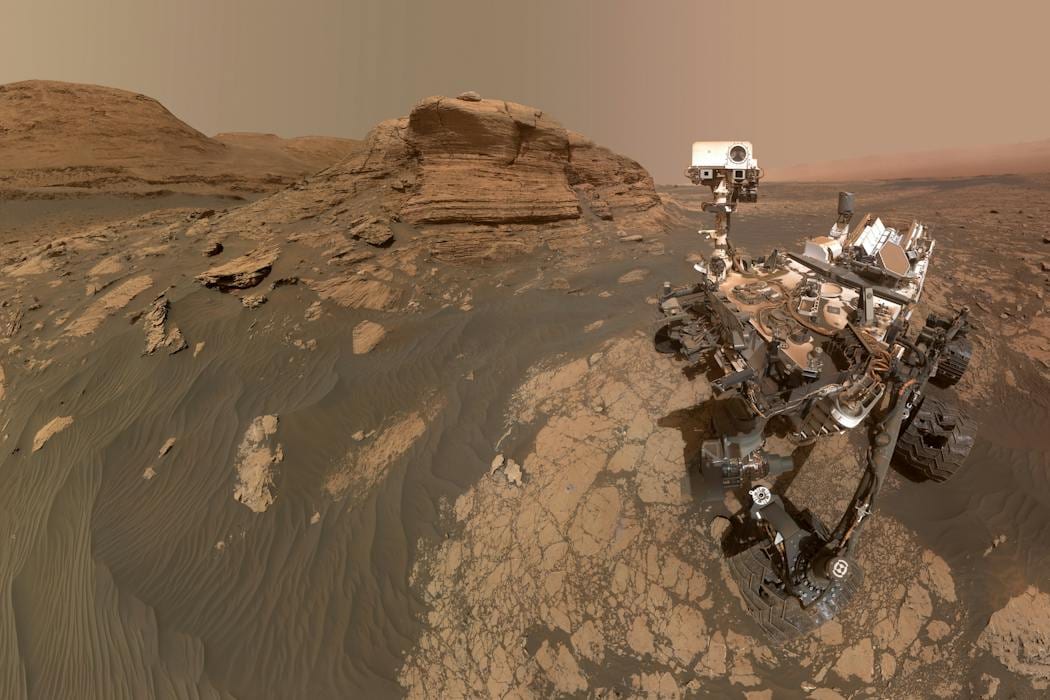
NASA built Curiosity to look for evidence of ancient habitable environments, meaning places with liquid water and the chemicals, nutrients and energy sources life requires. That goal called for a long-lived, mobile spacecraft that let scientists on Earth explore a local area remotely, choose rock samples and analyze them in onboard laboratories. JPL built the car-size, drill-equipped rover, and NASA added a suite of instruments and a science team drawn from the United States and other countries.
The rover was sent to Gale Crater to climb Aeolis Mons, a mountain whose 3 miles (5 kilometers) of sedimentary layers record environmental conditions from about 3.5 billion years ago. The evidence suggests a thicker atmosphere once sheltered flowing streams and lakes.
Curiosity has climbed through a vertical half-mile (1 kilometer) of those layers. It found clay-rich mudstones lower down, giving way at higher elevations to younger sandstones rich in salty minerals. The team concluded that lakes persisted for millions of years before the climate turned arid and dunes overtook them. Groundwater occasionally reached the surface and formed streams among the dunes.
Samples drilled from the lake sediments contain small organic molecules, which are carbon-based and are raw materials for potential life. Together with wet environments and a mix of chemicals similar to those microbes use for energy on Earth, the finding led the team to conclude that Gale Crater could once have supported life. Vasavada notes that settling whether life actually took hold would require bringing such rocks back to laboratories on Earth.
A Friday decision about polygons
Vasavada's account of one recent morning shows how the process handles surprises. During the previous shift, he asked the rover's route planners to head into an area that looked exceptionally smooth and flat in orbital images. After years of rough driving, the engineers drove the rover 120 feet (37 meters) across what the team called a Martian parking lot, a long distance for Curiosity.
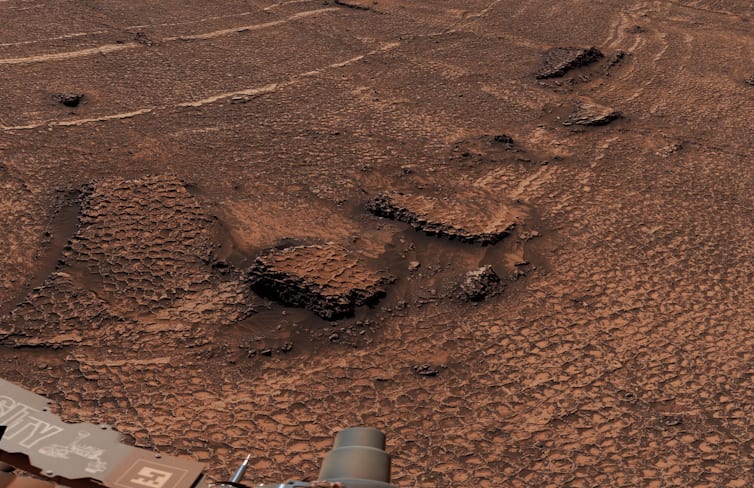
The new images showed something different. Instead of smooth slabs, every surface was textured by small polygons, each a few inches across, resembling honeycomb. Geologists on the team suspect the polygons outline fractures formed by drying, as in mud, or by thermal cycles or compression.
On screen, the terrain ahead of the rover was covered in dots, each a candidate target for the cameras, the laser spectrometer or the sensors on the robotic arm. There were too many. A science team member trained to moderate the discussion narrowed the list while faculty, postdocs and students from around the world argued for their targets. The debate turned on which images and chemical measurements would best show how the polygons formed. Vasavada serves as tiebreaker if consensus fails, though he says that is rarely needed.
Because it was Friday, the plan covered three days of weekend activity, and results would not arrive until the Monday shift. Curiosity works weekends.
From science request to command
After the science discussion, the work moves to engineers. In one room, a robotics engineer visualizes in 3D how the rover's five-jointed arm will reach the chosen targets. Nearby, another engineer simulates the next drive. The terrain beyond the polygon field is rough, with what Vasavada calls no more parking lot, all curbs, so she must plan a path around rock obstacles to the next science waypoint.
By noon the science team's formal role is finished, though many members stay online to discuss the data. Rover and instrument operators then convert the day's requests into the commands that go out through the Deep Space Network.
What this shows about the field
The account is a useful corrective to the idea that a Mars rover is simply driven from Earth. Curiosity's routine is closer to a daily negotiation among science goals, engineering limits and a communications schedule set by orbital geometry. The rover receives a plan once a day, and the team cannot correct it in real time. Everything in the plan must therefore be vetted in simulation first, which is why four of the seven hours go to command preparation rather than science.
The polygon episode also shows the value of that structure. An orbital image suggested a smooth surface, and the ground view contradicted it. A team that can reassess targets within a single shift can turn a surprise into a measurement plan the same day. That is a practical argument for keeping scientists closely tied to the engineering loop in long-duration planetary missions.
There are limits to what the account establishes. It covers one shift, and it does not report how often plans are revised or how much science is lost to the tight schedule. It does not say how the polygons formed, and the team's three explanations remain hypotheses until the new measurements are analyzed. The conclusion that Gale Crater could have supported life rests on organic molecules, wet environments and compatible chemistry, but the source is explicit that it does not show life existed. That question depends on sample return, which the account treats as a requirement rather than a plan.
The more durable lesson for robotics is operational. Curiosity has kept this cycle going for more than a thousand repetitions of the daily routine, which suggests that process discipline matters as much as hardware for a long-lived robot. Whether a team can sustain that rhythm with a rover that is aging and facing rougher terrain is a question the account raises but does not answer.