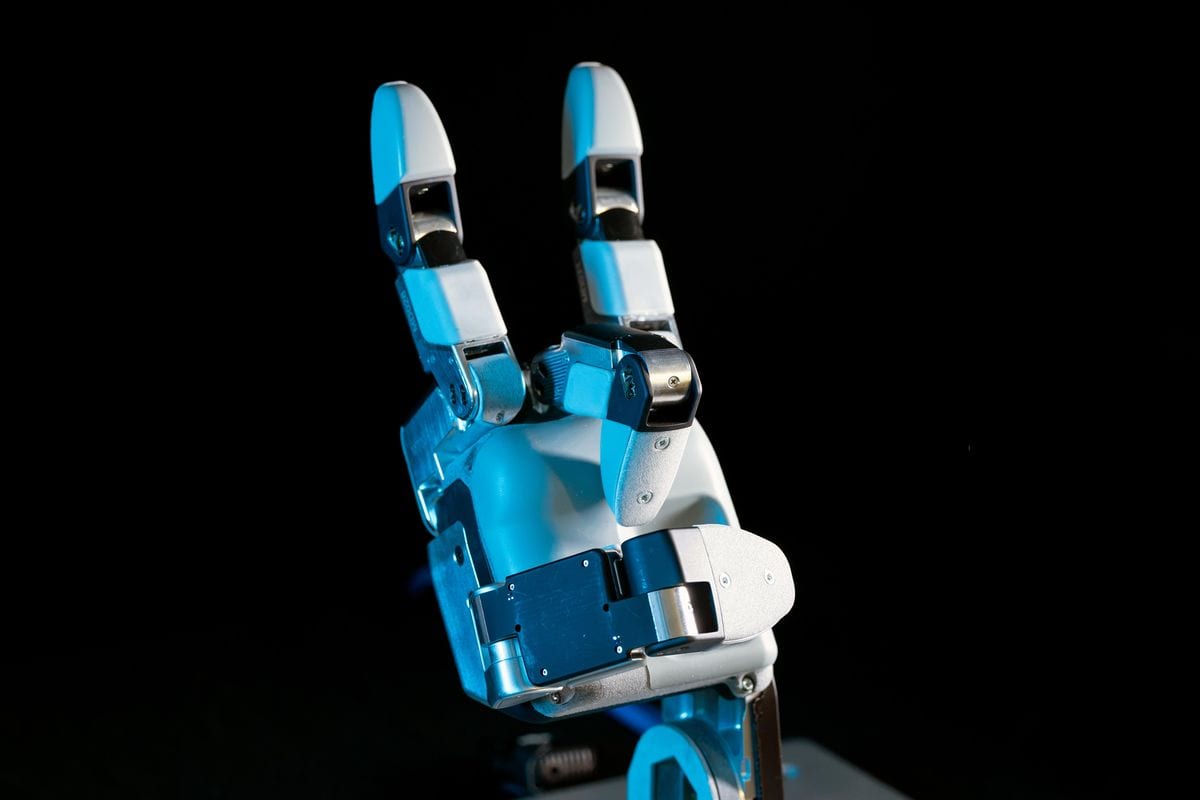
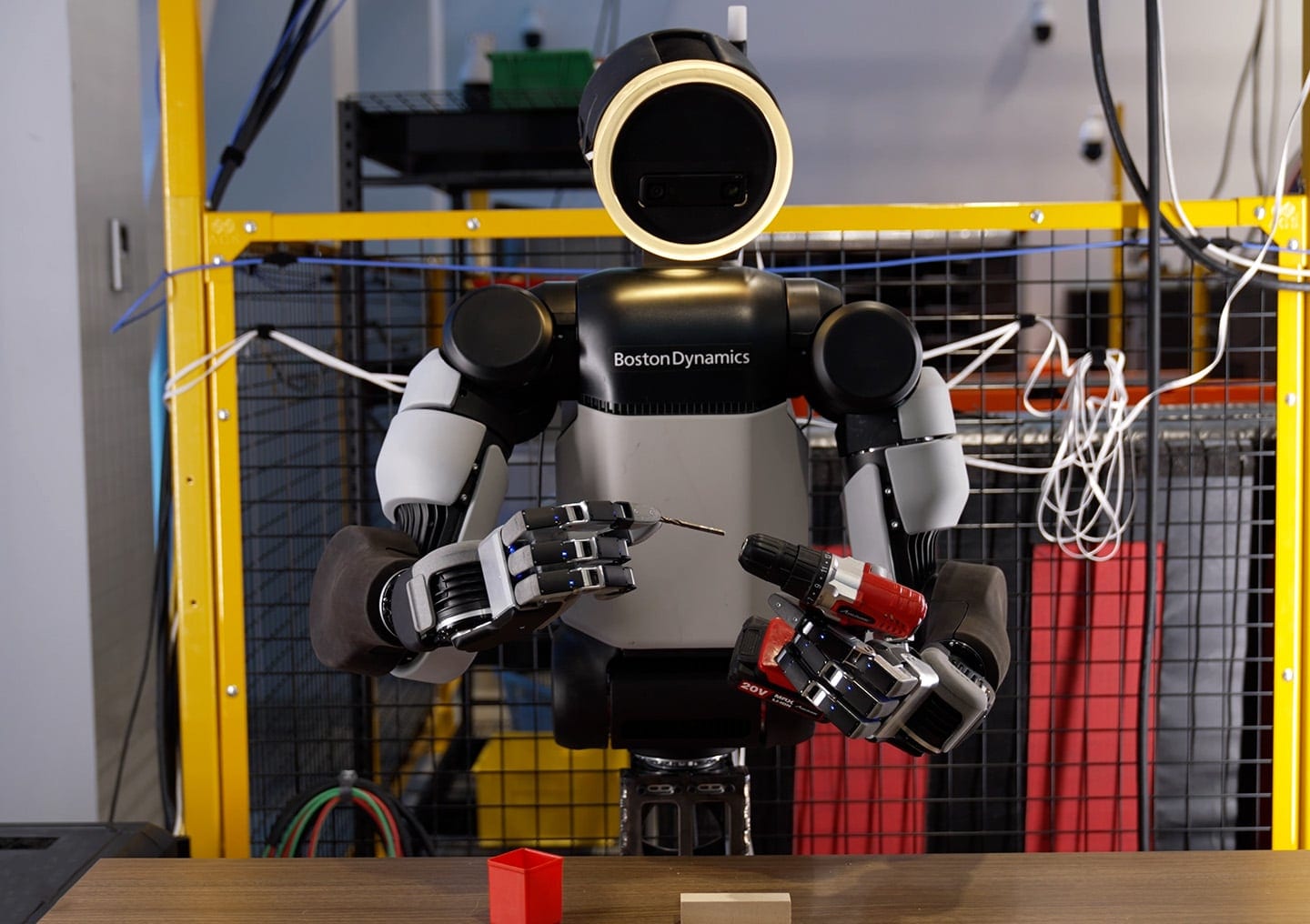
Boston Dynamics has redesigned the Atlas robot hand with three fingers and a thumb, 13 degrees of freedom, and no pinky. The previous Atlas hand had three fingers and 7 degrees of freedom. The company says the new design is built for rugged use, low-cost repair and manufacture in the tens or hundreds of thousands.
What changed from the last hand
The earlier Atlas hand could do some unusual things with its three fingers, but it was research hardware. It was never meant for mass production. Moving Atlas toward a product raised questions the research team could previously set aside: how to build a hand that does everything required while staying rugged, reliable and affordable.
The new hand answers with a complete redesign rather than one added finger. Degrees of freedom rise from 7 to 13. The hand has four digits, three fingers and a thumb, and it does not try to look like a human hand.
Boston Dynamics lists the design goals. The hand should handle a wide range of useful tasks, including using tools. It should be strong and rugged, and it should simulate cleanly. It should be manufacturable and repairable at reliably low cost. Its form factor should also be close enough to a human hand that human demonstrations can be used to train it. Looking cosmetically like a human hand is not on that list.
Why the pinky went and the fingers splay
Alberto Rodriguez, director of robot behavior at Boston Dynamics, says removing the pinky was a straightforward decision. His team spent a day with their pinkies taped to their ring fingers and concluded the finger could go.
The team added a fourth digit because the work demanded it. Rodriguez says one finger needed to be able to move against another. The hand also had to grip the handle of a tool with a trigger, a category that includes drills and welding torches. To manage this, the fingers can splay open.
That splay goes beyond what a human hand can do. Rodriguez says reinforcement learning can discover uses for these superhuman extra motions and exploit them. He also says that from a product perspective, the hand should be able to do everything the company needs for the foreseeable horizon.
Actuators built for repair and volume
Keeping the count at 13 degrees of freedom, below that of more anthropomorphic hands, lets Boston Dynamics use fewer, larger and more powerful actuators. The actuators sit directly in the joints in a direct-drive configuration. The transmission allows the motors to be back-driven, so the hand can react to force and contact.
Each actuator pack is a single unit that can be replaced easily. The hand has no delicate tendons or cables running across joints that could stretch and break. Reliability, manufacturability and cost are closely linked, and this layout addresses all three at once.
Rodriguez says the team is now working out which fine details of the design must change to build 100,000 of these hands a year. That figure describes the work under way, not a production run.
What the Atlas robot hand means for the field
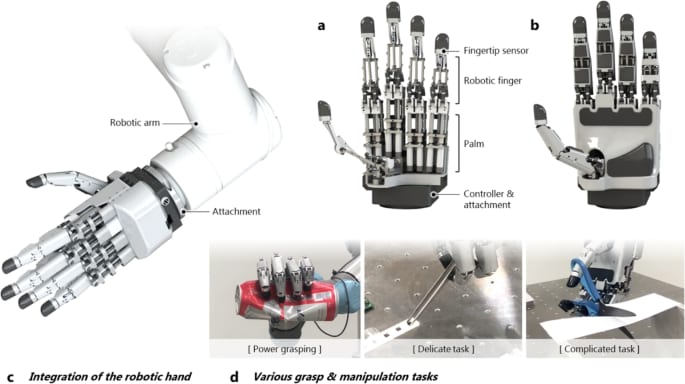
The Atlas robot hand is a deliberate bet against the prevailing look of humanoid hands. Several other humanoid companies have built hands that closely copy human anatomy, and some of those hands have performed dexterous manipulation that experienced observers find remarkable. Rodriguez's argument is that those designs give up reliability and manufacturability. Packing everything a hand needs into a human-sized form tends to make it fragile, expensive or both. For now, that leaves such hands suited mainly to research and demonstrations.
Boston Dynamics is making the opposite trade. It gives up human appearance and some degrees of freedom, and it gains replaceable actuator modules, no tendons and a path to volume. Each choice follows from a stated product goal, which is what makes the design coherent. The pinky decision came from a practical test, not from an assumption about what a hand should look like.
The design also keeps one link to human capability. Because the hand stays close to human form factor, human demonstrations can still be used for training. The extra splay then gives reinforcement learning room to find motions a human hand could not perform. How well those two training routes work together is the main technical question the design raises.
Much remains unproven. The announcement as described gives no price, weight, payload or grip-strength figures for the hand. It reports no durability testing or field data. The claim that the hand can do everything Atlas needs for the foreseeable horizon is Rodriguez's conviction, not a measured result. The 100,000-per-year figure is a goal the team is working toward, and the changes needed to reach it are not yet settled.
The comparison with humanlike hands is also untested in direct terms. Nothing in the announcement shows the Atlas hand matching the fine manipulation that more anthropomorphic designs have demonstrated. Rodriguez himself says that not every humanoid company will make the same trade-offs, and that there is room for creativity in hand design. The more useful measure will be whether hands built this way survive deployment and can be repaired and produced at the stated cost. If humanoids with hands are to scale, some compromise is unavoidable, and Boston Dynamics has now shown which compromises it is willing to make.