
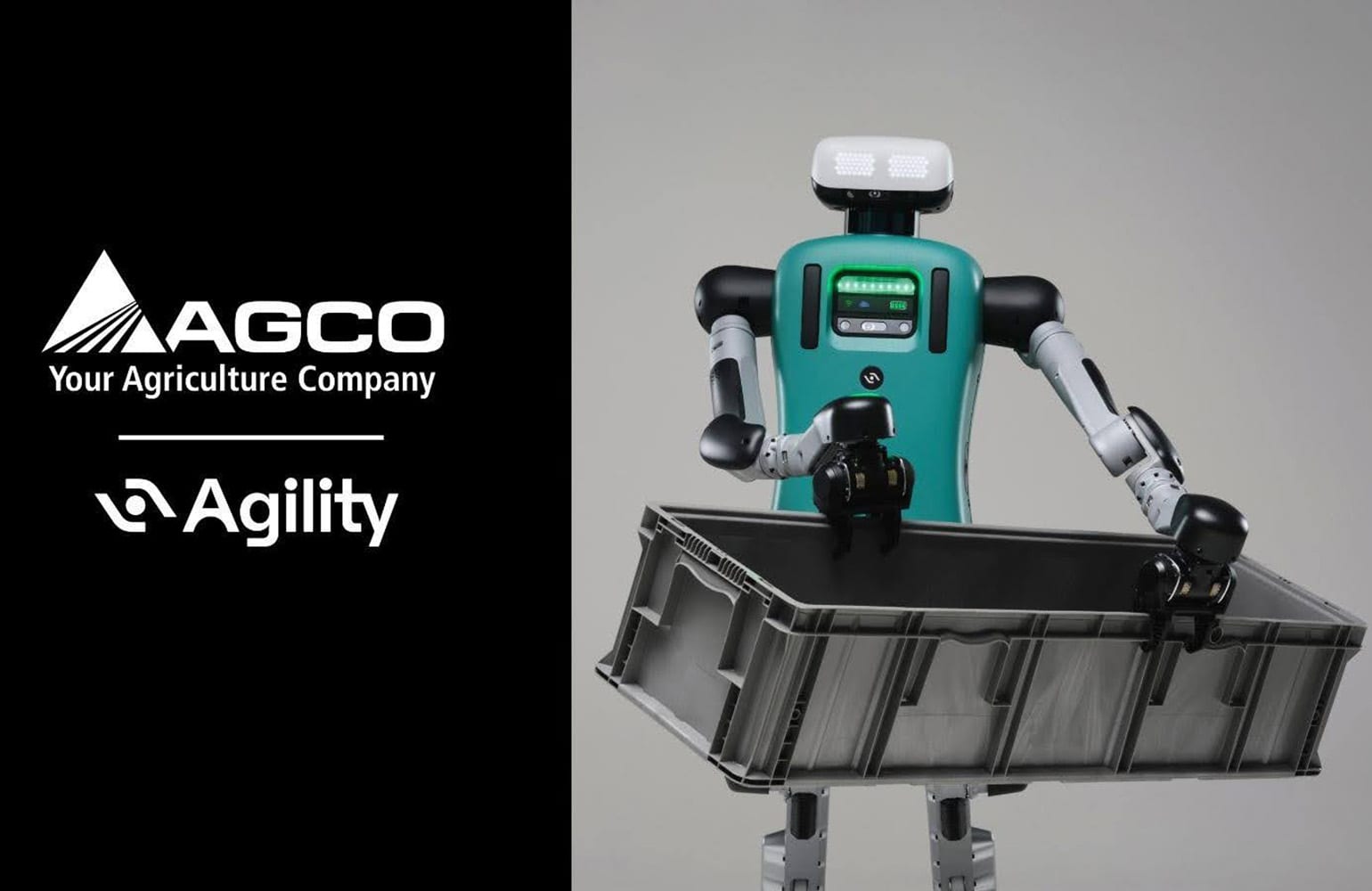
AGCO and Agility Robotics have signed a commercial agreement to put Agility's Digit humanoid to work at AGCO's production site in Hesston, Kansas. The pilot is expected to begin in 2027. It is a U.S. deployment, and AGCO says it will support its push toward more flexible, intelligent factories. The AGCO Digit humanoid agreement adds the agricultural machinery maker to Agility's customer list.
What the agreement covers
The deal is described as a commercial agreement, and the pilot starts at Hesston. The companies have not said how many robots will be deployed, what the contract is worth, or how long the pilot will run. They have also not said whether the program will expand to other AGCO sites after Kansas.
Agility says Digit will first support assembly and production operations. The listed tasks are sorting and stacking parts and placing totes for storage. Agility says the robot will improve ergonomic safety and operational efficiency. It also says the robot will let employees focus on higher-value, skill-driven work.
Thomas Enghof, AGCO's director of manufacturing technology, framed the project around the idea of robots as teammates. He said humanoid robotics and AI can unlock automation in complex, human-centric workflows by absorbing repetitive, strenuous or hazardous tasks. He also pointed to strict safety governance and said the goal is manufacturing systems that deliver measurable business value.
Daniel Diez, Agility's chief business officer, said the deployment is an opportunity to strengthen manufacturing processes and support employees in demanding tasks. He also said it would show how advanced robotics can create measurable impact in modern production environments.
The company and the robot
AGCO is based in Duluth, Georgia. Its brands include Fendt, Massey Ferguson, PTx and Valtra. The company describes itself as a global leader in agricultural machinery and precision agriculture technologies. Its product range includes smart farming systems, brand-agnostic retrofit technologies and autonomous offerings.
Agility says Digit uses AI to learn continuously and adapt to changing workflows. The company pairs the robot with Agility Arc, a cloud-based platform for deploying and managing robot fleets. Agility says this combination lets companies add automation to essential operations without extensive infrastructure changes or costly facility upgrades.
AGCO joins Toyota, GXO Logistics and Schaeffler on the list of companies Agility names as deploying its humanoid robots.
Agility's wider moves
The AGCO agreement follows the unveiling of Digit 5, the latest version of the robot. Agility says Digit 5 has new legs, upgraded batteries and a more comprehensive safety architecture. The company, based in Salem, Oregon, has also confirmed that it is exploring wheeled robots for its customers.
Agility is also preparing to go public through a previously announced merger with Churchill Capital Corp XI. The business combination is expected to close in the fourth quarter of 2026. The combined company would then operate as Agility Robotics and is expected to trade on Nasdaq under the ticker symbol AGLT.
Analysis: what this does and does not show
The agreement is a signed commitment, but the work it describes is modest. Sorting and stacking parts and placing totes are material-handling jobs. They are well defined and repetitive, and they involve moving objects between known locations. Those are the kinds of tasks a first humanoid deployment can reasonably take on. The agreement does not point to welding, assembly of heavy components or other work that would test the limits of a bipedal platform.
The timing also matters. The pilot is not expected to start until 2027, so the Hesston deployment cannot yet show results. The companies cite measurable impact and business value, but neither has published a figure, a target or a metric. No throughput numbers, safety records, uptime data or cost comparisons accompany the announcement. Until the pilot produces them, the claims of improved efficiency and ergonomics remain claims.
The comparison with other deployments is limited by what has been disclosed. Agility names Toyota, GXO Logistics and Schaeffler as customers. A named customer list shows commercial interest, but it does not show how many robots each company runs or how long they have run them. AGCO's own pilot is framed as a starting point at one site. It is a pilot rather than a fleet rollout.
Two other facts bear on how to read the deal. Agility says it is exploring wheeled robots for customers. That suggests the company is weighing whether a legged form factor is needed for every task its customers want done. A tote-moving job on a factory floor is one where that question matters. The merger with Churchill Capital Corp XI is expected to close in the fourth quarter of 2026. Once Agility is a public company, customer announcements like this one would sit alongside regular financial reporting. That would give outsiders a way to check whether pilots turn into larger orders.
For the field, the useful signal is the customer type. AGCO builds heavy agricultural equipment, which is a different production environment from a warehouse. If the Hesston pilot works, it would extend the evidence for humanoids in manufacturing settings. What remains unproven is whether Digit can hold up on a factory floor at scale, whether the safety governance AGCO describes holds in daily use, and whether the economics justify more than a pilot. The 2027 results will be the first real test of those points.