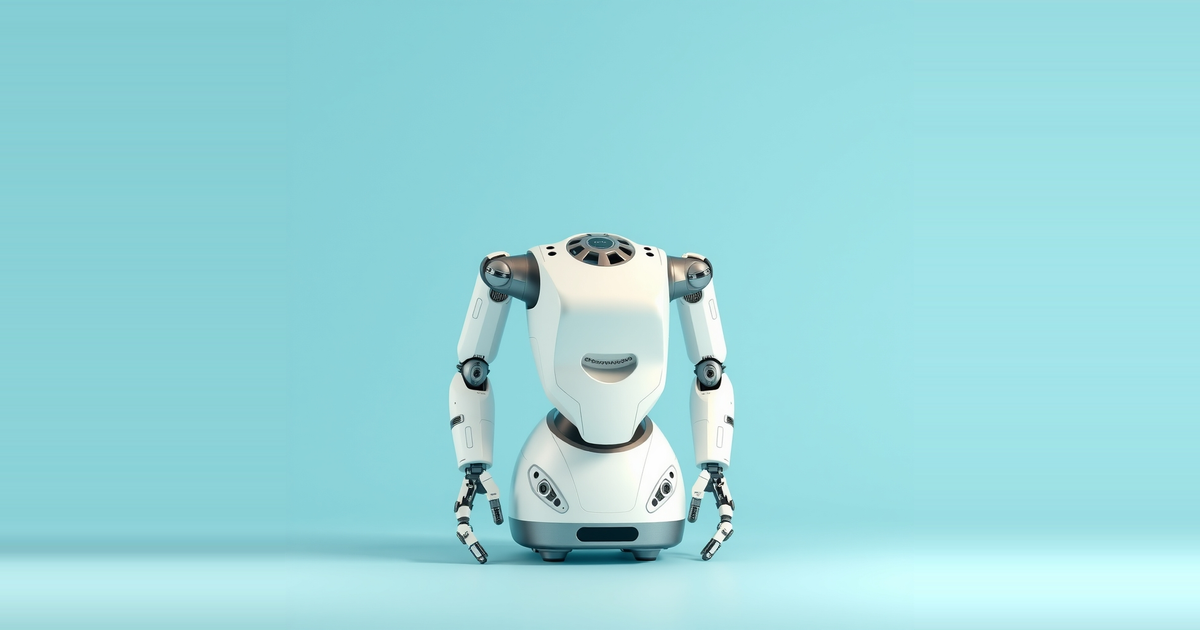
Rika Antonova, an Associate Professor at the University of Cambridge, spoke on a robotics podcast on 16 October 2026 about using artificial intelligence to develop robot hardware and algorithms together. The conversation, with host Claire, was episode 166 of a weekly series. It centred on robot co-design: building a machine's body and its control software as one problem rather than two.
The published description of the episode is brief. It gives the topic and the guest's background, and it does not report specific results, experiments or robots. This article sets out what is stated and what the topic implies for the field.
The idea of designing body and brain together
The episode was framed around developing complementary robot hardware and algorithms. The word complementary matters. It implies that the physical form and the software are chosen to fit each other, instead of one being fixed first and the other adapted afterward.
Antonova's listed research interests include co-design, which is the subject of the conversation. The episode title refers to evolving robot bodies and brains, which signals an approach in which both parts change over the course of the design process. The description does not say which methods the discussion covered, which robots were involved or what was measured.

The guest and her research
Antonova holds an Associate Professor position at the University of Cambridge. Her stated research interests are co-design, automated algorithm discovery, data-efficient reinforcement learning, exploration, active learning and robotics.
Several of these interests sit close together. Automated algorithm discovery points to using computation to find control methods rather than writing each by hand. Data-efficient reinforcement learning points to learning behaviours from limited experience. Exploration and active learning concern how a system decides what to try or what data to gather next. The description does not link these to specific projects, so any connection between them and her co-design work is an inference from the list rather than a reported finding.
Her training spans several institutions. She completed a research Master's degree at the Robotics Institute at Carnegie Mellon University and a PhD at KTH Royal Institute of Technology. She then held a Computing Innovation Fellowship at Stanford University. Before that, she worked as a senior software engineer at Google.
Where the episode sits in the series
The series describes itself as a weekly podcast on robotics, artificial intelligence and autonomous machines. Episode 166 followed episode 165, in which Claire spoke with Kushant Patel of Brookhaven National Laboratory about robots that work in scientific facilities such as particle accelerators. Episode 167, released a week after Antonova's, features Jan Petrš of École Polytechnique Fédérale de Lausanne discussing novel robot designs for construction and architecture.
Taken together, the three episodes cover robots in research facilities, robots designed through AI, and robots designed for building work. Two of the three concern how robot form is chosen for a particular job.
What this means for the field
The facts available here are limited, so the analysis below rests on the topic and the guest's stated interests, not on reported results.
Robot co-design addresses a real structural split in robotics. Hardware and software are usually developed by different teams on different timelines. A control algorithm is then tuned to a body that already exists, and the body carries design choices that may limit what any algorithm can do. Treating the two as one search problem is a response to that limit. The episode's framing, complementary hardware and algorithms, points to this motivation.
The pairing with data-efficient reinforcement learning is a reasonable fit, though the description does not confirm it. Searching over bodies and controllers together multiplies the number of candidates to evaluate. If each evaluation requires physical hardware, the cost grows quickly. Methods that learn from less data would therefore matter more in a co-design setting than in a fixed-body one. That is a logical relationship between two of her listed interests, not a documented result.
Comparison with other work is limited by what the source provides. The description names no benchmark, prototype or competing approach, so it cannot be said how her methods perform against hand-designed robots or against other automated design efforts. The neighbouring episode on construction robots shows the same question from the application side: when a task is unusual, a custom body may help, but someone has to decide what that body looks like.
Several points remain unproven on the evidence available. The description does not say whether co-designed robots have been built and tested, how well designs found in simulation carry over to physical machines, or how much computing a given search needs. It also gives no timeline for any technique reaching products. Readers should treat the episode as a statement of research direction from a Cambridge academic with experience in industry and robotics research, not as evidence that the approach has been validated.
What can be said is that the question is well defined and the guest's background fits it. Her path runs from robotics research at Carnegie Mellon, through a PhD, a fellowship at Stanford and software engineering at Google, to a faculty post at Cambridge. The full conversation is where any specifics would be found, and those specifics are what the field would need to judge whether designing bodies and brains together can outperform designing them apart.