
North American companies ordered 10,989 robots valued at $723.5 million in the third quarter of 2026, according to the Association for Advancing Automation (A3). That is 24.8% more units and 26.1% more value than in the third quarter of 2025, and it makes Q3 the strongest quarter of the year so far. The figures put North American robot orders on a firmer footing after a mixed first half.
Nine-month totals
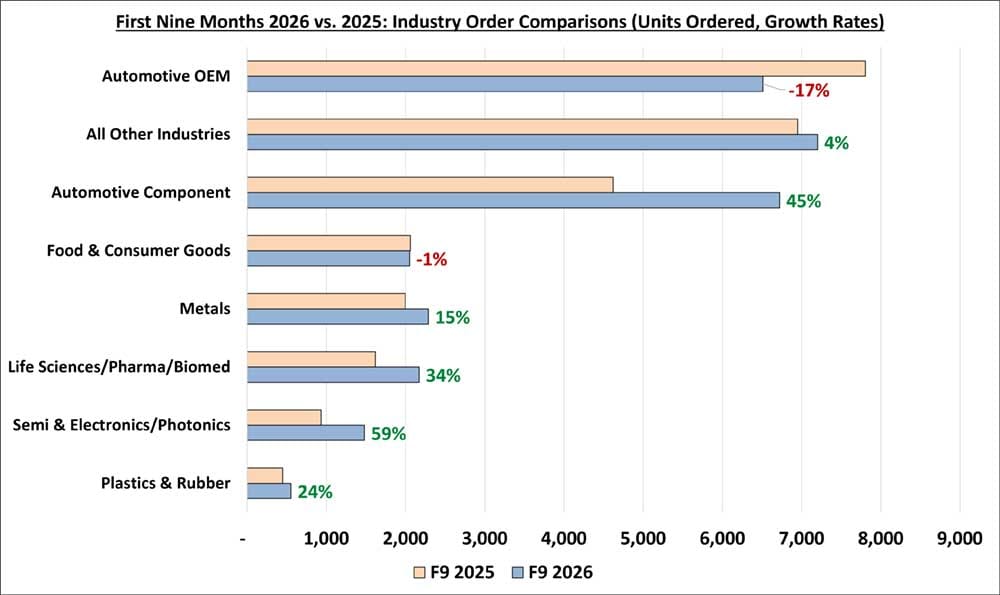
The third-quarter gains lifted orders for the first nine months of 2026 to 28,984 robots valued at approximately $1.89 billion. Against the same period last year, that is an increase of 9.6% in units and 13.3% in value. The Ann Arbor, Michigan-based organization reported the data.
The gap between the quarterly and nine-month growth rates shows how much of the year's progress arrived late. Q3 grew at 24.8% in units, while the nine-month figure stands at 9.6%. Orders in the first half were therefore much closer to flat than the headline quarter suggests.
Automotive recovers, other sectors surge
Automotive OEM robot orders returned to positive year-over-year growth in the third quarter, rising 7.5% after declines in the first half of 2026. The recovery is partial. Through the first nine months, OEM orders remained 17% below their level a year earlier.
Orders from automotive component suppliers climbed 90.4% in the quarter, continuing strong demand from that segment earlier in the year. A3 said component orders were particularly strong despite the earlier weakness among automotive manufacturers.
Several other industries posted substantial unit increases in Q3:
Semiconductors and electronics/photonics rose 97.6%. Plastics and rubber rose 67.7%. Life sciences, pharmaceutical and biomedical rose 38.7%. Metals rose 37.0%.
All other industries combined increased 0.5% in units, and food and consumer goods declined 23.7%.
A3 linked the electronics growth to rising investment in U.S. semiconductor manufacturing and strong demand for electronics supporting AI and other applications. It tied life sciences growth to continued investment in domestic pharmaceutical manufacturing, among other factors.
Alex Shikany, executive vice president at A3, said the notable feature of the quarter was how widely the growth was spread. He said automotive OEM orders returned to growth while automotive components, semiconductors and electronics, and life sciences posted significant gains. In his view, that mix points to a market becoming more diversified across industries and applications.
Collaborative robots
Force- and power-limited, or collaborative, robots also had a strong quarter. Companies ordered 1,831 units valued at $63.8 million, an increase of about 56% in units compared with Q3 2025. Collaborative robots made up 16.7% of all robot units ordered in the quarter.
Through September, North American companies ordered 4,605 collaborative robots valued at approximately $178 million. That represents 15.9% of total robot units and 9.4% of order value. In the first nine months, collaborative robots accounted for 43.8% of robot orders in life sciences, pharma and biomedical, and 36.9% in semiconductors, electronics and photonics.
Manufacturing backdrop
A3 said the order growth coincides with improving manufacturing activity. The September ISM Manufacturing PMI registered 54.5, the ninth consecutive month of expansion. The Federal Reserve said U.S. manufacturing output rose 0.3% in September.
A3 listed higher input costs, trade uncertainty and the timing of large manufacturing projects as factors to watch. It said the North American market enters the final quarter of 2026 with positive momentum.
What the numbers do and do not show
The strongest signal in the data is the change in who is buying. Automotive has long been a anchor customer for industrial robots, and OEM orders are still 17% lower over nine months. Growth is now being carried by component suppliers, semiconductor and electronics plants, plastics, metals and life sciences. A market that depends on more sectors is less exposed to one industry's capital spending cycle, which supports A3's diversification argument.
The collaborative robot figures fit that pattern. Collaborative units grew about 56% in the quarter, well ahead of the 24.8% market rate, and they hold their largest shares in life sciences and electronics. Those are sectors where the data shows high growth. Collaborative robots are only 9.4% of order value, though, so they remain a small part of the dollars even as their unit share approaches one in six.
Several points remain unproven. One quarter is a short basis for calling a trend, and the nine-month growth of 9.6% in units is far more modest than the Q3 headline. The sector gains are reported as percentage changes in units, and the source does not give the underlying counts, so a 97.6% jump in electronics could sit on a small base. The all-other-industries category was nearly flat at 0.5%, and food and consumer goods fell 23.7%, so the recovery is not universal.
The causal links to chip fabrication investment and domestic drug manufacturing are A3's explanations, not something the order data itself demonstrates. Orders are also not installations, and the data does not say when the robots will be delivered. The risks A3 named, including input costs, trade uncertainty and project timing, could slow conversion of orders into deployments. The fourth-quarter figures will show whether the broader mix holds.