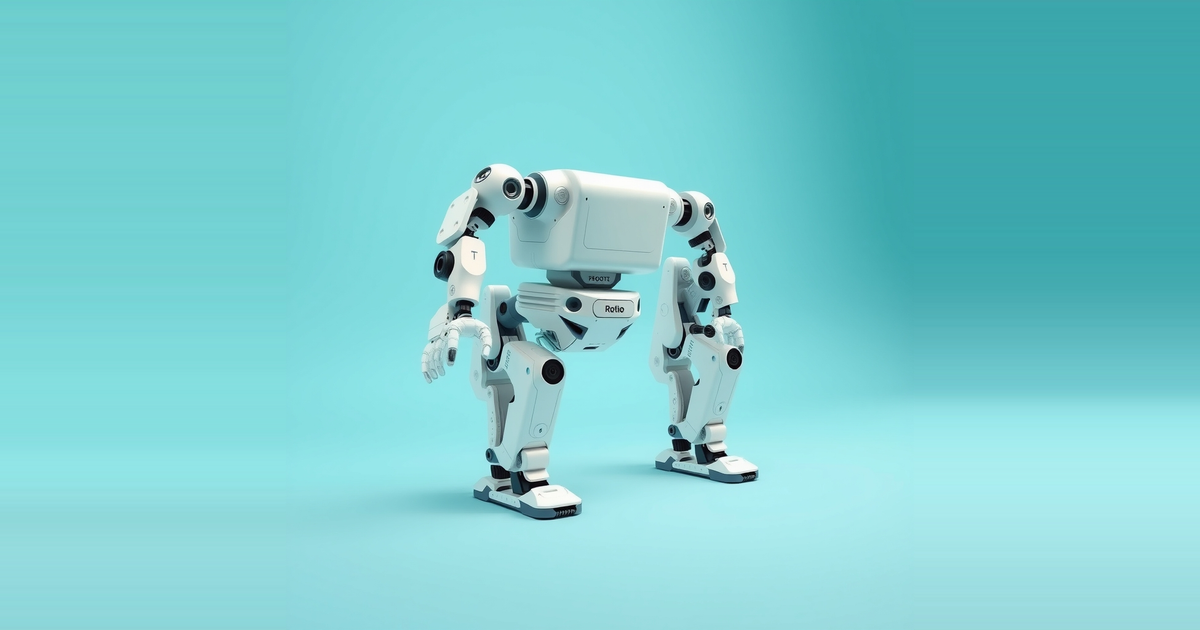
Machina Labs builds a robotic blacksmith called RoboCraftsman, a system that shapes complex metal parts for the aerospace, defence and automotive industries. Its co-founder and chief executive, Edward Mehr, discussed the machine in a conversation with the host Claire, published on 12 June 2026 as the 160th episode of a weekly robotics podcast.
The facts disclosed about the system are narrow. It forms metal, the parts it makes are complex, and its customers sit in three sectors that depend on metal components. The conversation did not come with published figures for price, size, payload, speed or production volume, so none are reported here.
What RoboCraftsman does
RoboCraftsman is described as a robot that shapes complex metal parts. The name points to a human trade, and the robotic blacksmith label fits the task: working metal into a required form rather than assembling or moving finished pieces.
The three target industries are aerospace, defence and automotive. Each uses formed metal parts, and each has its own demands on geometry and material. The source does not say which parts RoboCraftsman has made, which alloys it handles or how many units are in service. Those details would show how far the system has moved beyond demonstration.
The source also does not describe the mechanism. It does not say whether the system uses one robot or several, what tooling it carries or what sensing it relies on. A reader should treat the description as a statement of purpose, not a technical specification.
The company and its chief executive
Machina Labs is the company behind RoboCraftsman. Mehr is its co-founder and chief executive. He is described as an entrepreneur and engineer who specialises in advanced manufacturing, robotics and artificial intelligence.
In his role, Mehr leads the company's efforts to integrate AI-driven robotics into flexible, on-demand production systems. That phrase is the clearest statement of the company's approach. It describes production that can change what it makes and can make parts when they are needed, with artificial intelligence guiding the robots.
The company is also described as reshaping how aerospace, defence and automotive firms approach metal forming and modern manufacturing. That is the company's own framing of its aims. The source offers no independent measurement of that effect.
Where Mehr worked before
Before founding Machina Labs, Mehr worked at several technology and engineering companies: Relativity Space, Averon, SpaceX, Google and Microsoft. The list spans launch vehicle manufacturing, large-scale software and consumer and enterprise computing.
The source does not say what role Mehr held at any of them, or how long he stayed. It would be wrong to assign him a specific contribution at any employer. What the list does show is a background that mixes aerospace hardware with software, which matches a company that pairs metal forming with AI-driven control.
Analysis: why it matters and what is unproven
The most useful signal in this story is the pairing of flexible with on-demand. Metal forming has traditionally been tied to the parts it produces, and changing a part can mean changing the equipment set up to make it. A robotic system that shapes complex parts and is directed by software points at a different arrangement, in which the part design changes and the machine adapts. That is an inference from Mehr's stated goal of flexible, on-demand production, not a demonstrated result in the source.
The choice of customers supports that reading. Aerospace, defence and automotive buyers all use metal parts, but they differ in how many units they need and how often designs change. A system aimed at all three suggests Machina Labs wants a capability that is not locked to one product line. The source does not say which of these industries has bought the system, so the breadth of the target market should not be read as breadth of adoption.
Comparison with other approaches is limited by what the source provides. It gives no figures for cycle time, accuracy, material range or cost per part, so no claim can be made that RoboCraftsman is faster, cheaper or more precise than conventional forming or than other robotic fabrication systems. Any such comparison would need data that has not been released in this material.
Several questions remain open. The first is repeatability: whether the system produces parts within the tolerances that aerospace and defence buyers require, across many units. The second is scale: how many machines are deployed, and whether output can meet production demand rather than prototype demand. The third is the role of AI: the source says the company integrates AI-driven robotics, but it does not say what the AI decides, how it is validated or how errors are caught. The fourth is cost, since no price is stated for the system or for the parts it makes.
These gaps are normal for a product described through an interview rather than a technical paper or a customer case study. They also define what to watch for. Published tolerances, named customers, deployment counts and independent testing would turn a description of intent into evidence.
For the wider field, the story is a reminder that robotics is moving into the shaping of material as well as the handling of objects. Whether the robotic blacksmith becomes a standard tool in factories will depend on measured performance, not on the framing of the trade it is named after.