A self-driving chemistry platform that its developers estimate costs around $5,000 to build is now documented in full, down from more than $50,000 for its predecessor. RoboChem Flex is an autonomous synthesis robot designed by a team led by Professor Timothy Noël at the University of Amsterdam's Van 't Hoff Institute for Molecular Sciences. The group describes it in Nature Synthesis, and the paper contains the information a laboratory needs to construct its own unit.
From a $50,000 system to a $5,000 one
The first RoboChem appeared in the journal Science in early 2024. It paired an autonomous flow chemistry system with a benchtop NMR instrument for analysis, and a machine learning unit controlled the whole setup. Working around the clock, it could optimise the synthesis of ten to twenty molecules without human intervention. Noël's group says that workload would take a PhD student several months.
The hardware had a drawback. Noël says the system cost more than 50,000 dollars, and that figure did not include the NMR equipment, which is also expensive. Such platforms are often priced so that only well-funded institutions can buy them. Noël calls that exclusivity counterproductive. In his words, scientific progress requires scalable, cost-effective tools that empower researchers across all resource levels.
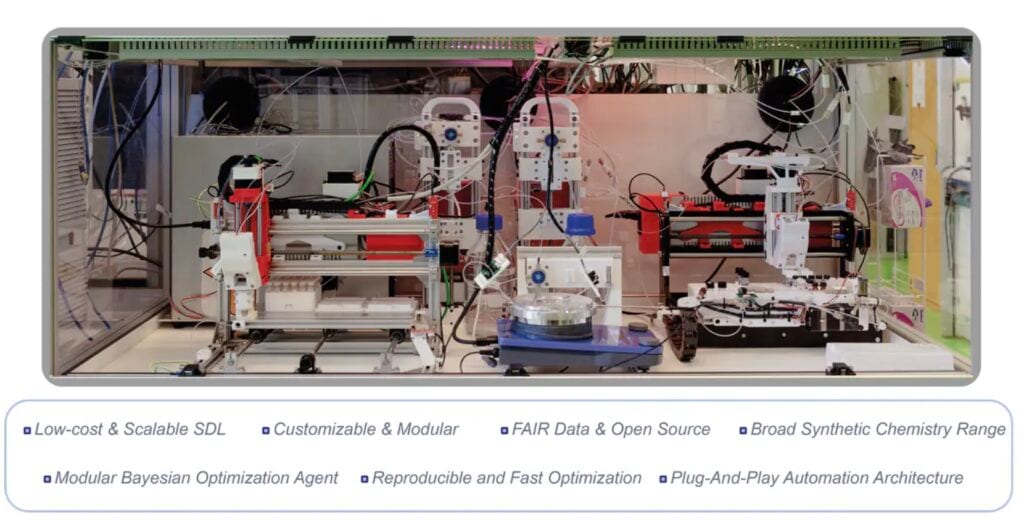
RoboChem Flex is the group's response. The estimated cost is around $5,000, and the platform covers photocatalysis, biocatalysis, thermal cross-coupling and other areas of chemistry. Noël notes that other affordable automated systems exist but tend to focus on narrowly defined problems, which limits the research they can support.
Off-the-shelf parts, 3D printing and open software
To keep costs down, RoboChem Flex uses readily available components or 3D-printed equivalents. The group says this lowers the price and also allows fast customisation and iterative development.
Communication between hardware modules runs through OmniPlatypus, a software package written in-house by Noël's group and released as open source. It supports a plug-and-play architecture and requires minimal coding from the user.
The optimisation layer is a modular Bayesian Optimisation agent. Users can adjust it to match the goals of a particular experiment. The platform can connect to several inline analytical instruments, including NMR, UHPLC-MS and Raman spectroscopy. With these attached, it can run closed-loop reaction optimisation autonomously, 24 hours a day.
All code is available on GitHub. That includes the machine learning and optimisation code, graphical user interface software, device firmware, operational control code, 3D printing design files and hardware schematics.
A human-in-the-loop option for labs without inline analytics
Inline analytical instruments can cost far more than the robot itself, and the group acknowledges that the cost could significantly exceed the $5,000 price of the base system. To address this, the team built a 3D-printed liquid sampling unit.
The module collects reaction samples. Researchers then analyse them on equipment the lab already has, which Noël says is often shared among several research groups. This human-in-the-loop approach is meant as a practical, affordable way into automated optimisation. The group says it aims to give resource-limited laboratories tools comparable to those at well-funded institutions.
Six case studies
The team tested RoboChem Flex on six case studies in different areas of chemistry. They are the optimisation of pyrrole trifluoromethylation using adaptive weighted exploration and NMR analysis; deoxygenative C–H functionalisation through hypervolume optimisation with HPLC analysis; noisy hypervolume optimisation of photocatalytic isotope labelling with Raman spectroscopy; and selective enzymatic reduction of a diketone using human-in-the-loop operation and dual acquisition batching.
The remaining two are the optimisation of Buchwald-Hartwig aminations through transfer learning and ligand featurisation, and the multi-objective optimisation of an enantioselective photocatalytic [2+2] cycloaddition using chiral HPLC. Noël says each study shows how the platform can be tailored to the problem at hand. The group also ran the syntheses its optimisations proposed in the laboratory to check that the results hold up in practice.
The Nature Synthesis paper, titled A flexible and affordable self-driving laboratory for automated reaction optimization, lists Simone Pilon, Elia Savino, Oliver M. Bayley and Noël among its authors, along with a number of co-authors.
Analysis: what the price cut does and does not settle
The main significance is the combination of a lower price and full documentation. A tenfold or greater drop from the original system's cost, together with open code, design files and schematics, removes two barriers at once: the purchase price and the need to reverse-engineer a system. For an autonomous synthesis robot, publishing the build details is as important as the cost figure, because it lets other groups modify the platform rather than only use it.
The comparison with the first RoboChem needs care. The $50,000 figure excluded the NMR equipment, and the $5,000 figure excludes inline analytics. The two numbers are not a like-for-like measure of a complete working setup. A lab that wants fully closed-loop operation would still have to buy instruments that the source says could cost far more than the robot. The human-in-the-loop sampling unit gets around this, but it trades away some autonomy, since a person must carry samples to the analyser.
Against other affordable automated systems, the source's own claim is that those tools sacrifice research potential by focusing on narrow problems. Six case studies across photocatalysis, biocatalysis and cross-coupling offer evidence of breadth. That evidence comes from the developing group, however, and the source reports no results from other laboratories.
Several questions remain open. The $5,000 figure is an estimate, and the source gives no breakdown. It does not state how many molecules RoboChem Flex can optimise or how quickly, so whether it matches the original system's output is unknown. Whether outside groups can build it from the paper with minimal difficulty has not been shown. Those results will determine whether the platform widens access to autonomous chemistry in practice, or mainly gives well-equipped groups a cheaper option.