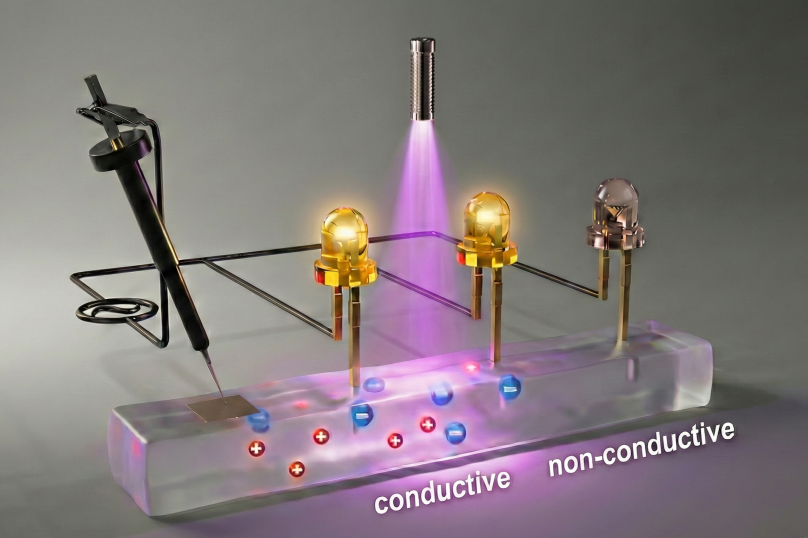
A soft rubber bar with three lightbulbs has shown how a light-activated gel can switch from insulator to conductor. Light shone on the first two stations of the bar made them conductive, and their bulbs came on. The third station got no light, stayed nonconductive, and its bulb stayed off.
The demonstration comes from engineers at MIT and colleagues, who report that the material becomes 400 times more conductive when exposed to light. The work was published in Nature Communications in 2026 as an open-access paper titled "Soft photo-ionotronics."
Ions instead of electrons
The material belongs to ionotronics, a field that moves data with ions, which are charged molecules, rather than with electrons. Electronics built on electrons is well established. Ionotronics is still being developed, with one large exception: living systems. Cells in the body communicate with ions ranging from potassium to sodium.
That overlap is why the field interests device designers. Living tissue is generally soft and squishy, while conventional electronics is hard and rigid. Ionotronics can act as a bridge between the two. The applications named by the team include soft wearable technology and human-machine interfaces, along with biocompatible devices and soft robotics.
Other groups have already made ionotronic materials with high conductivity that lets ions move quickly. Those conductivities cannot be controlled once the material is made. The MIT approach adds a control: light decides where and when the material conducts.
"We've found a mechanism to dynamically control local ion population in a soft material," says Thomas J. Wallin, the John F. Elliott Career Development Professor in MIT's Department of Materials Science and Engineering, who led the work. He says this could allow a system that adapts itself to environmental stimuli, in this case light. The system could change automatically as light changes, which could allow complex signal processing in soft materials.
How the gel is made
The key ingredient is a class of materials called photo-ion generators, or PIGs. On their own, PIGs can become about 1,000 times more conductive when exposed to light. The team needed a way to place one inside a soft, stretchable host.
They chose polyurethane rubber. The researchers first dissolved a PIG powder in a solvent. They then used a swelling method to draw the dissolved PIG into the rubber. The team optimized this process, according to the paper's description of the work.
"What we're doing is using light to switch a soft material from insulating to something that is 400 times more conductive," says Xu Liu, first author of the paper. Liu is a former MIT postdoc in materials science and engineering and is now an incoming assistant professor at King's College London.
The circuit in the demonstration shows what that switch looks like in practice. A copper electrode is attached to the left end of a rectangular bar of the gel. A stylus and an associated metal network connect the electrode to three stations on the bar. Each lit station became conductive and powered its bulb. The unlit station did not.
The additional authors are Steven M. Adelmund, Shahriar Safaee, and Wenyang Pan, all listed with Reality Labs at Meta.
Limits and next steps
In the material reported so far, the change in conductivity is irreversible. Once light has switched a region on, it stays on. Liu is confident that future versions could switch back and forth between insulating and conducting states.
The current material uses only one kind of PIG, one polymer, and one solvent. Many other kinds of all three exist, which Liu says leaves great potential for better light-responsive soft materials.
The team also wants to change the trigger. Liu says the group is inspired to replace light with other environmental stimuli, such as heat or magnetism. She describes the potential for a subfield she calls soft photo-ionotronics, and says the group is excited about new soft machines for wearables, human-machine interfaces, robotics, and biomedicine.
What this means for soft robotics
The most useful feature here is spatial control. Light can be aimed at one region of a bar and leave the neighboring region untouched, as the three-station circuit shows. For soft robots, which usually lack the rigid boards and wiring that hard robots rely on, a body material that can be patterned by light offers a route to routing signals through the structure itself.
The comparison with earlier ionotronic work is clear from the facts. Existing materials already offer fast ion movement, but their conductivity is fixed. This gel gives up that fixed state in exchange for a switchable one. The 400-fold change in the rubber is smaller than the roughly 1,000-fold change seen in PIGs alone. That gap suggests some conductivity contrast is lost when the PIG is carried in polyurethane, although the work does not say why.
Several things remain unproven. The irreversibility is the largest limit. A one-way switch suits a circuit that is configured once, such as writing a conductive path into a bar. It does not suit a sensor or logic element that must change state repeatedly. Liu expects reversibility to be possible, but it has not been shown in this material.
The work also does not report how quickly the material responds or how long the conductive state lasts. It gives no figures for stretchability or for performance in a deforming robot body. Biocompatibility is cited as a field-level goal of ionotronics, not as a result for this specific gel. Those properties will decide whether the light-activated gel moves beyond a laboratory demonstration.
The single-formulation result also cuts both ways. It is a narrow test of a design space with many untested combinations of PIG, polymer, and solvent. A better formulation may exist, but none has yet been shown. The claim that the work could underpin a new subfield rests on that open space, not on measured performance across materials.