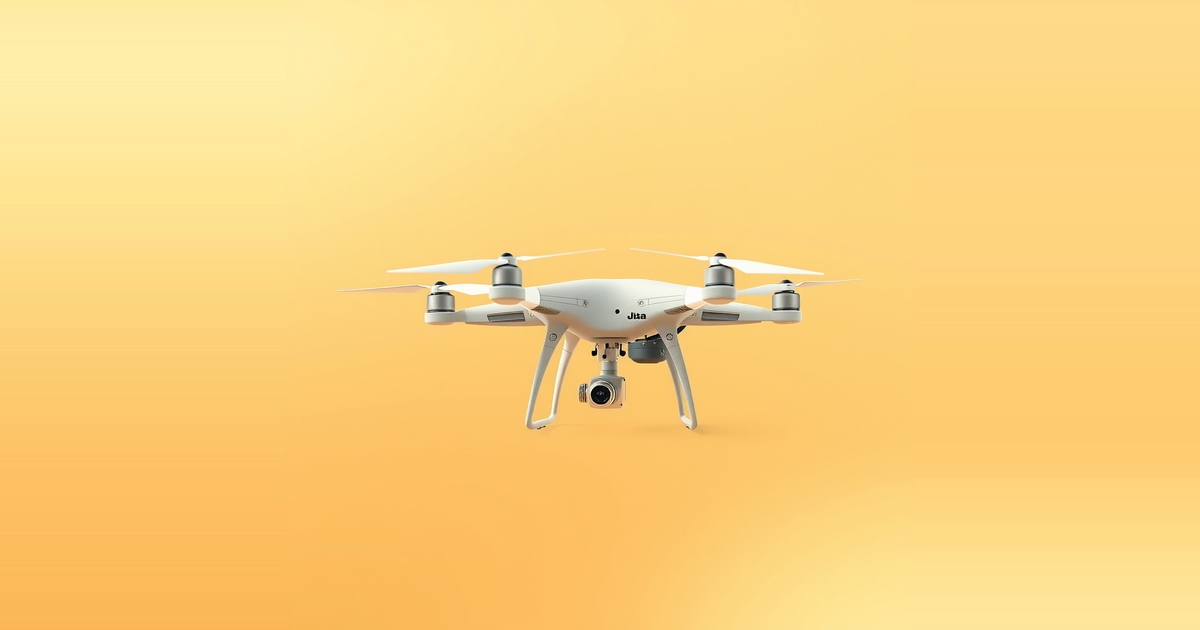
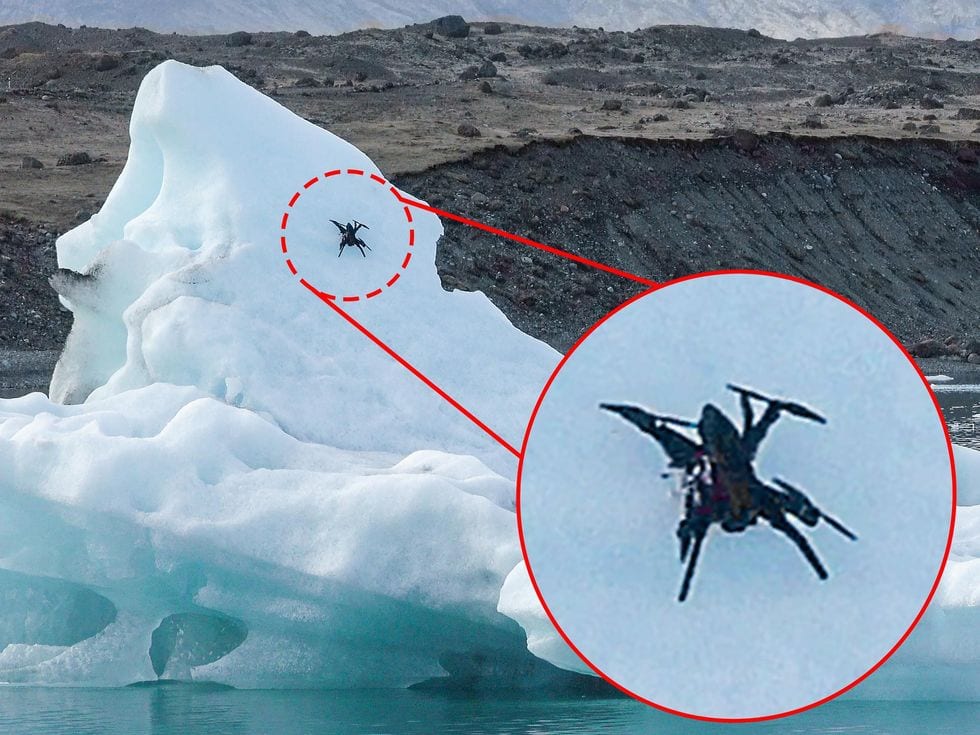
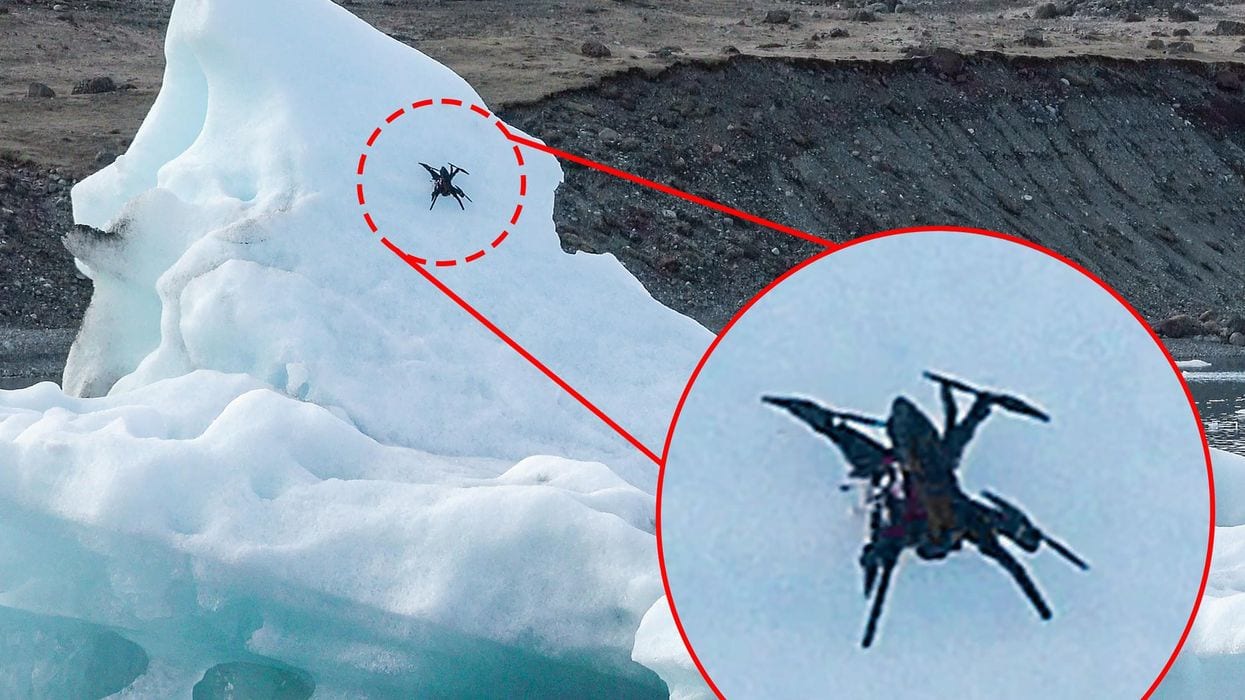
A 2.65 kg carbon-fiber drone called Ice Dart has landed and held on to ice slopes of up to 58 degrees at a glacier in southeast Iceland. The iceberg perching drone was built by a team at Université de Sherbrooke in Quebec, Canada, and it grips with small retractable spines on each foot.
The results appear in IEEE Transactions on Field Robotics. They describe a drone that can settle on steep, slippery surfaces such as icebergs and glaciers, where flat and stable landing sites do not exist.
Tests at Fjallsjökull
The field trials took place at Fjallsjökull, a glacier in southeast Iceland that empties into a lagoon filled with icebergs. Conditions included persistent wind and temperatures between 0 and 10 °C.
The drone perched at speeds of up to 3 meters per second and on slopes of up to 58 degrees. The researchers report a 100 percent success rate in wind speeds of 30 km/h. A slope of nearly 60 degrees is steeper than most people could handle without special equipment.
The work comes from a group that has already built drones able to land on fast-moving trucks, trailers, boats and steep roofs. The motivation is a practical limit on drone operations. The availability of safe landing sites is one of the main constraints on where and how drones can be used.
Landing gear built to absorb the hit
Ice Dart has four legs arranged in an X shape, each attached to the body by a pivot joint. The landing gear was used in the group's earlier drone research. It is designed to absorb the impact of a hard landing while holding the aircraft in place.
The friction shock absorbers use 38 disks that generate friction torque as the legs move up and down on impact. This lowers the drone's center of mass and spreads out the kinetic energy of the landing.
The gripping is done by two retractable spines on each foot, one for uphill grip and one for downhill grip. The larger spine engages on the more heavily loaded downhill feet. The smaller, thinner spine engages more easily on the uphill feet, even under very low loads on steep slopes. The spines penetrate the ice only as the suspension compresses. That produces the grip and also shields the spines from high-impact forces.
Isaac Tunney, a postdoctoral researcher in mechanical and robotics engineering at Université de Sherbrooke and lead author of the paper, said the design was inspired by a cat's claws, which deploy only when needed. He wanted feet that engage passively at the right moment, regardless of the drone's orientation, the surface geometry or the ice conditions.
Why land at all
Alexis Lussier Desbiens, a professor of engineering at Université de Sherbrooke and a coauthor, said that landing rather than hovering changes how drones can be used. Once the drone has landed, energy consumption drops sharply, which allows much longer observation periods with a small aircraft. A perched drone is also silent. It can reduce or eliminate its thermal and radio-frequency signature by shutting down major onboard systems.
For icebergs, the researchers say perching would let a drone monitor one for days or months. That would give more detailed observation than a brief aerial surveillance pass. They see it as a possible simplification compared with helicopter deployment, dropped instruments or dart-like tracking devices. It could add a data layer to satellite and ship-based iceberg detection. It could also make it possible to follow icebergs that are otherwise untrackable.
William D. Harcourt, a researcher at the University of Aberdeen in Scotland who studies Arctic glaciers, snow and sea ice, was not involved in the study. He said that near the front of tidewater glaciers, such systems could measure stress and strain and help explain calving. A drone could act as a mobile GPS receiver on the ice. He noted a problem, however. Three-dimensional change measurements usually require the antenna to be horizontal, so the system would need to handle tilt. If that is solved, he said, it could be used to track iceberg movements.
What comes next, and what it means
The team plans to add autonomous landing site selection and an emergency takeoff capability for cases where an iceberg rolls over or breaks apart. The drone is also set to be deployed in August on a Canadian Arctic mission, where it will land on icebergs, collect data and help validate ship-based iceberg-detection systems.
This section is our analysis. The Iceland results show that a small drone can reliably hold on to steep, wet ice after an impact landing. That is the hard mechanical step, and the passive design is notable because the spines need no sensing or actuation to engage. Fewer active parts means fewer things to fail in cold, remote conditions.
The comparison with existing tools follows from what the researchers list. Helicopters, dropped instruments and dart-like trackers each place a device on or near an iceberg, and satellites and ships observe from a distance. A perching drone sits between these. It can be repositioned, and in principle it can leave and land again, which a dropped tracker cannot do. That argument depends on the drone being able to take off again, and the source does not report that this has been demonstrated on ice.
Several points remain unproven. The Iceland tests ran at one glacier in temperatures of 0 to 10 °C, and the Arctic mission will be a harder test of cold, ice variety and weather. The source does not report perching durations in the field, so the claim of days or months of monitoring is a stated goal rather than a result. Harcourt's tilt concern means that a drone on a 58-degree slope cannot yet serve as a precise GPS station. Autonomous site selection and emergency takeoff are still planned work, and an iceberg that rolls with a drone attached is exactly the case they are meant to cover.
The August mission, in which the drone's data will be used to check ship-based detection systems, is the clearest test of whether the Ice Dart can move from a field trial to a working tool.