
The Federal Communications Commission determined in July that certain foreign-made advanced robots pose a cybersecurity and competitive risk to the United States, and it has restricted imports of new models of advanced robotic devices, including mobile robots and legged robots. A webinar scheduled for 2:00 p.m. ET on Tuesday, Oct. 27, 2026, was set up to explain what the FCC robotics ruling means for companies that buy automation.
The session brought together the chief executives of Vecna Robotics and Locus Robotics with the director of market intelligence at the Association for Advancing Automation, known as A3. It was free to attend and sponsored by Vecna Robotics. Panelists were to take questions during the live broadcast, and the recording is available on demand to registrants.
The questions buyers now face
The FCC action leaves purchasers with practical problems that go beyond whether a given robot can be imported. The organizers framed the central questions around design, deployment, and ongoing support. A company that buys a mobile robot is also buying software, connectivity, and a service relationship, and each of those can be affected by a regulatory decision about the hardware.
The panel was set to examine how connected systems differ from traditional automation. That distinction sits at the center of the cybersecurity concern the commission cited. A fixed machine that runs in isolation presents a different risk profile from a fleet of mobile robots that communicate with servers and with each other.
Attendees were also promised a look at how to evaluate the long-term supportability of a robotics investment. The agenda included perspectives on strengthening supply chains, the questions buyers should put to their technology providers, and what the changing landscape could mean for the U.S. robotics industry.
What the session covered
The organizers listed several learning goals. Attendees were to identify which types of robots and companies are affected by the FCC action, and to understand the intent behind the restriction. They were also to learn about other U.S. policies under consideration, with tariffs named as one example.
The agenda then turned to buyer strategy: building acquisition, implementation, and service plans designed for resilience. It also included tracking how the robotics ecosystem is reacting to U.S. and competitive challenges, and awareness of standards efforts that run alongside regulatory changes. A final item looked at long-term trends in automation.
The panel
Karl Iagnemma is CEO of Vecna Robotics Inc., a material handling systems provider. He holds a Ph.D. from MIT and previously directed the MIT Robotic Mobility Group. He founded nuTonomy, a driverless car software company that Aptiv acquired for $450 million. Under his leadership, nuTonomy was spun out into Motional, a $4 billion joint venture with Hyundai Motor Co.
Rick Faulk is CEO of Locus Robotics Corp., a warehouse automation supplier. He has more than 30 years of experience in executive management, sales, and marketing at technology companies that include Cisco, WebEx, Barracuda Networks, Lotus Development, and PictureTel. He sits on several boards and advises multiple companies.
Aaron Prather directs market intelligence at A3, where he turns raw market data into guidance for the organization's executive leadership. He has more than two decades of experience across research and development, standardization, and strategic planning in automation, robotics, and operations management.
Eugene Demaitre moderated. He has led discussions on reshoring at RoboBusiness 2026.
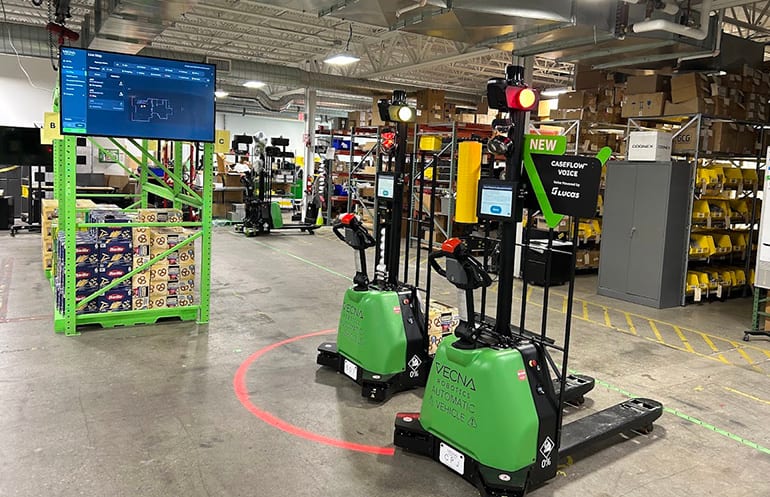
Vecna Robotics makes its systems in the U.S. and is not directly affected by the FCC ruling. That fact matters when reading the panel, since the sponsor sits outside the group of companies the restriction targets.
Analysis: why this matters and what is unproven
The most useful signal in this event is its framing. The organizers did not present the FCC action only as a trade matter. They presented it as a procurement problem, with supportability, supply chain strength, and vendor questioning on the agenda. That is a sensible reading of the ruling, because the commission's stated concern is cybersecurity and competitive risk, and both attach to a robot's whole lifecycle rather than to its purchase price.
The restriction, as described, applies to new models. That wording points to a gap buyers will need to close for themselves. Robots already deployed are a separate question from models that have yet to arrive, and the source does not say how installed fleets, spare parts, or software updates are treated. Companies running or planning mixed fleets will have to ask vendors directly about update paths and service commitments rather than assume continuity.
The comparison with tariffs is also worth noting. The organizers named tariffs as another policy under consideration, and the two tools work differently. A tariff raises the cost of a product. An import restriction on new models can remove options from the market altogether. Buyers who model only price effects would miss that difference.
Several points remain unproven from the information available. The source does not state which companies or specific products fall under the FCC determination, so any claim about who is winning or losing would be speculation. It does not say how the commission defines an advanced robotic device beyond naming mobile and legged robots as examples. Nor does it show how buyers are actually changing their purchasing behavior.
The panel's composition adds a caution. Two of the three speakers lead companies that sell robots into warehouses and logistics operations, and one of them sponsored the event and builds in the U.S. Their views are informed, but they are not neutral on how buyers should weigh domestic manufacturing. The A3 representative adds an industry-wide view, though the organizers did not say what his data shows.
For the field, the practical takeaway is that cybersecurity and sourcing questions are moving from the IT department into the first stage of robot selection. Whether that shift is lasting will depend on how the FCC applies its determination and on whether the standards efforts the webinar mentioned produce requirements that buyers can verify.