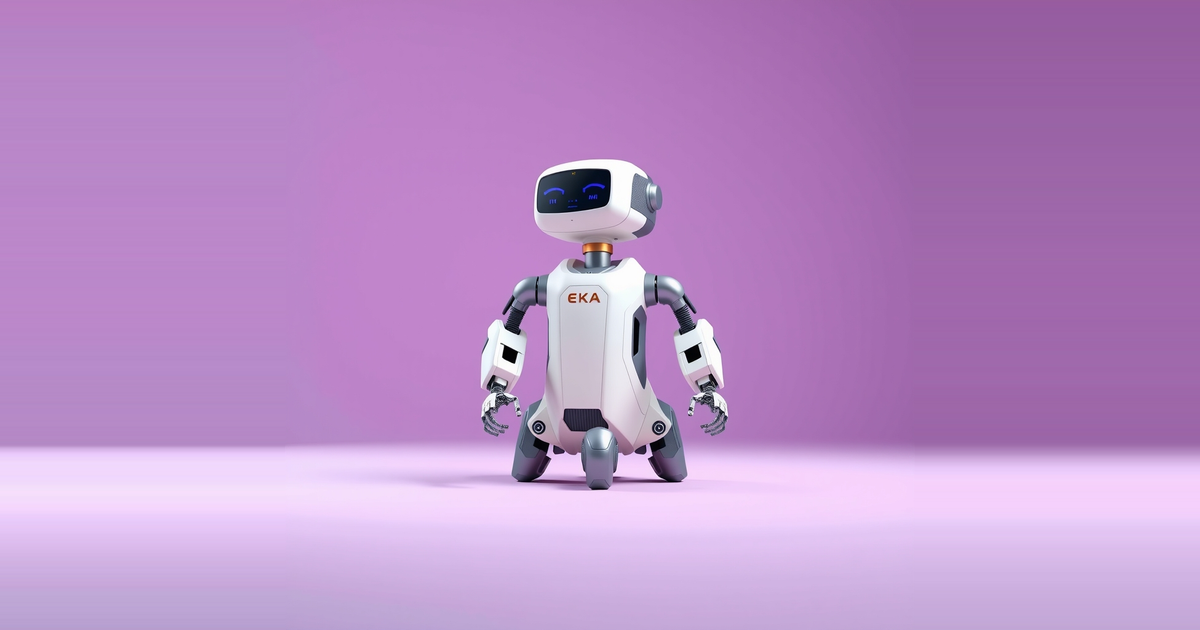
Eka Robotics has raised $150 million in Series A funding to scale its vision-force-action model and expand customer deployments. Andreessen Horowitz (a16z) and F-Prime, a venture fund affiliated with FMR LLC, the parent company of Fidelity Investments, led the round.
The Cambridge, Mass.-based startup was founded in 2024. It says its vision-force-action (VFA) model gives robots an intuition for physics, learned through reinforcement learning at scale. The company says robots running the model can pick a wide variety of objects that fall outside the training distribution at roughly 1,500 operations per hour.
What the model is meant to do
Eka is aiming at dexterous manipulation. The company argues that robots doing complicated work need two things: the versatility to cope with changing conditions, and the performance to deliver useful output every day.
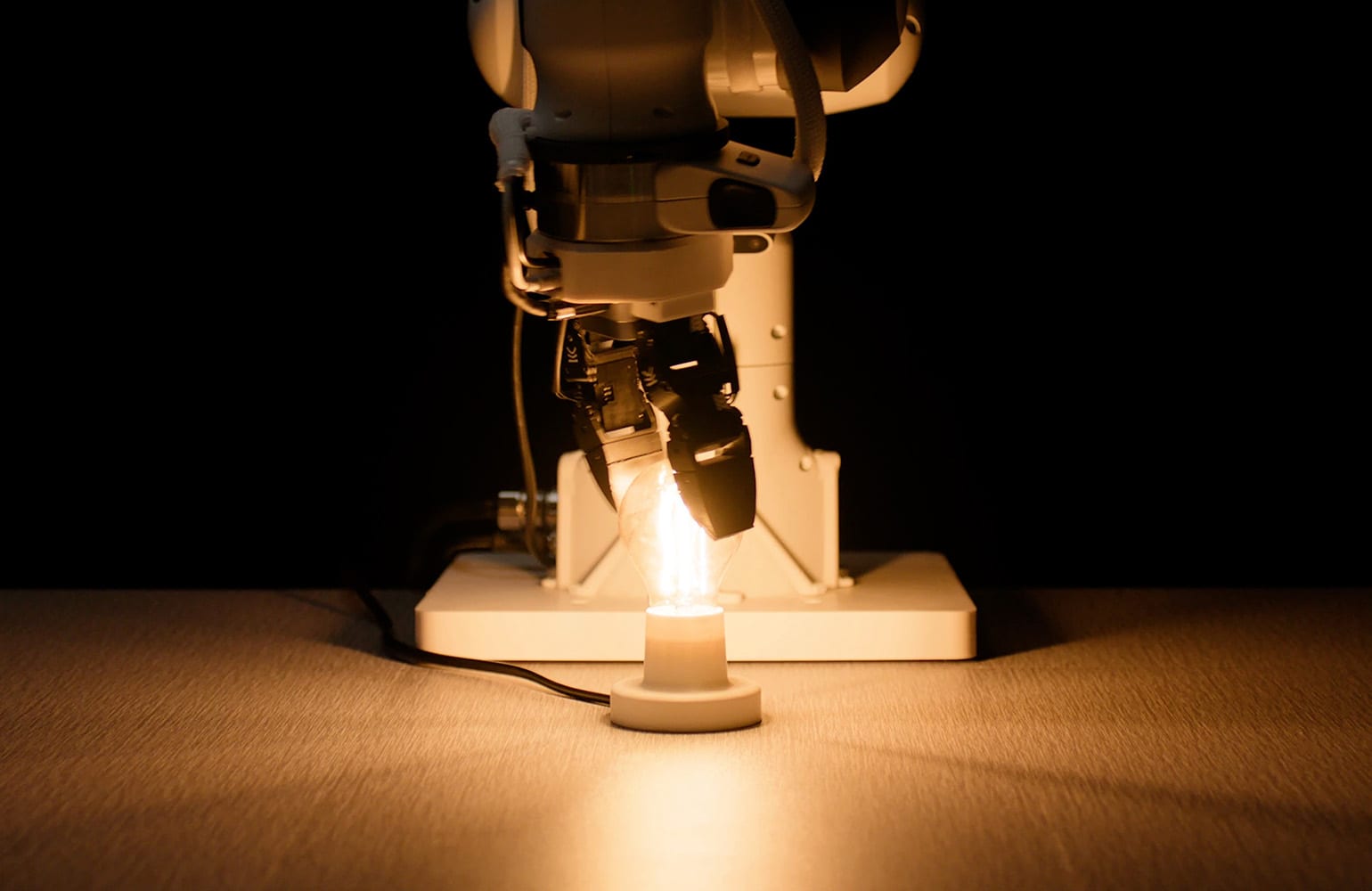
Its VFA model reasons jointly about vision and forces. Eka says this lets a robot build intuition about a task in a way comparable to how a person does. The company also says the same robots can screw in a light bulb and insert wires. Those are Eka's own assertions, and the company has not released detailed performance data for them.
Eka holds that robots should master physics rather than mimic human data if they are to become truly general-purpose. That position sets it apart from approaches built on human demonstrations. In its words, "Reinforcement learning at scale buys performance, and breadth of experience buys generality."
Training in simulation
The company relies on simulation learning. It says it can generate thousands of hours of robot experience in minutes, varying objects, environments, and physical conditions. Eka says its VFA model shows the usual sim-to-real barrier is falling, and that transferring simulated learning to the real world gives a scalable, performant, and capital-efficient route to a foundation model for manipulation.
The company did not detail how much of the model's real-world performance comes from simulation versus real-world data. It also did not name the customers or the sites where its robots are deployed.
Who is backing the round
Eka's seed investors Obvious Ventures and E14 Fund continued their support in the Series A. Other funding came from MFV Partners, Bison Ventures, Glasswing Ventures, Samsung Next, and several Fortune 500 strategic investors. The company did not name those strategics.
Raghu Raghuram, a general partner at a16z, called the VFA model "the first approach I've seen that truly solves manipulation with the generality and throughput needed for deployments." He added that the team has "the ideal DNA to push the frontier of robotics research while scaling commercial operations."
Shyam Kamadolli, a managing director at Fine Structure Ventures, framed the problem in factory terms. "From the factory floor, a robot's value comes down to two things: its success rate and its speed over thousands of repetitions," he said. He argued that current approaches to generalization will not get there, and that the next level of performance requires a deep understanding of physics and a break from dependence on human demonstrations. He said he believes Eka's approach is the only one that will hold up in real-world deployments of complex tasks.
The round size and the investor list indicate that backers are willing to fund a physics-first, simulation-heavy bet on manipulation. The investor quotes, however, are opinions from people with a financial stake, not independent measurements.
Analysis: what this means and what remains unproven
The most useful detail in the announcement is the throughput figure. Many manipulation demonstrations show that a robot can complete a task. Fewer state how many it completes per hour. Eka's figure of roughly 1,500 operations per hour, on objects outside the training distribution, speaks to the metric Kamadolli names: success rate and speed over thousands of repetitions. That is the right yardstick for factory and logistics buyers, and it is the one Eka will be judged on.
The approach also takes a clear side in a live debate. One camp builds manipulation skill from human demonstrations. Eka argues that demonstrations cap performance and that reinforcement learning in simulation, with force as a core input alongside vision, is the better route. Including force in the model's name is a notable design choice. Tasks such as inserting wires or threading a bulb depend on contact, and vision alone does not capture that.
Several points are still unproven. The 1,500-operations figure is a company statement, and the source gives no success rate, no description of the object set, and no description of the test conditions. Without a success rate, the speed number cannot be judged on its own. The claims about screwing in a light bulb and inserting wires are also unaccompanied by reported results.
The sim-to-real claim carries the most weight. Eka says the barrier is falling, but it has not shown how well the model holds up across different hardware, sites, and long production shifts. Nor has it said how many customers are running the system today. The funding is meant to scale deployments, which suggests the real test is still ahead.
The statement that no other company achieves this is a claim by an investor, not a comparison with published benchmarks. Until Eka or an independent party publishes head-to-head results against demonstration-driven systems on the same tasks, the claim stays an assertion. The next signals to watch are named customer deployments, sustained uptime figures, and any release of evaluation data.