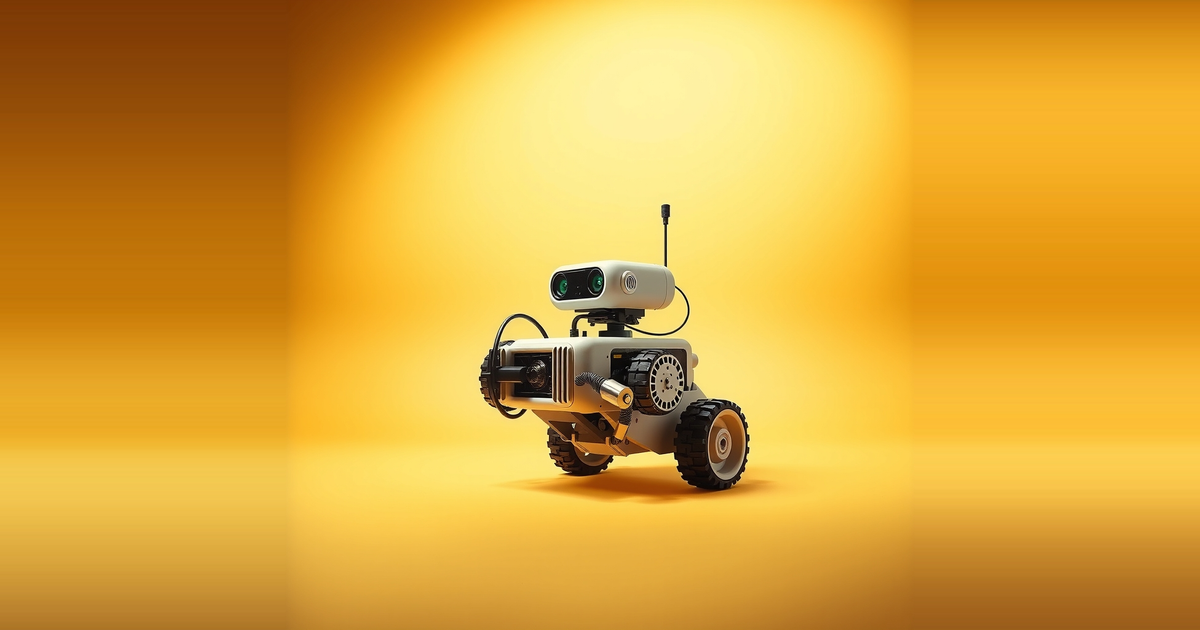
A team of Cornell undergraduates beat 95 other teams to win the grand prize at The Farm Robotics Challenge on May 21 with a weed-killing robot that uses electricity instead of herbicides. The machine drives itself through a vineyard or orchard without a human operator and zaps weeds with a small amount of electric current.
The students are now using the $50,000 prize to start a company, Rootline Robotics, and keep developing the machine. The team says the design saves labor and energy and prevents crop loss.
A four-month build
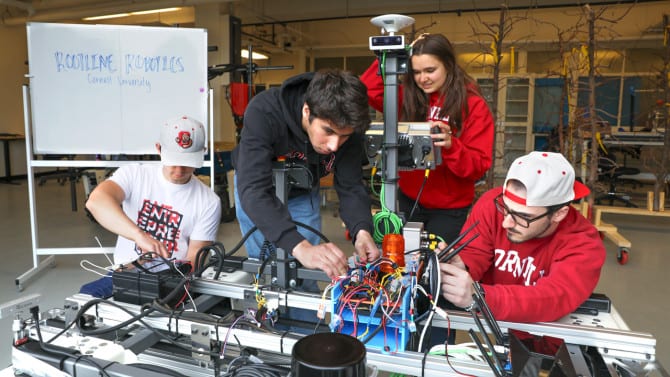
The project was led by Andrew James, an agricultural sciences major in the College of Agriculture and Life Sciences. The team combined agricultural specialists and engineers. Its members include Natalia Kurz, Michael Neiss and Neil Morrison.
The students began by studying existing electrical weeding technology. They then designed their own low-energy system and built a working prototype in four months. Kurz, a biological engineering major, said the schedule meant many late nights. "There were fears for us, like, was it just going to be for nothing?" she said.
Kurz described the field in terms that match the team's makeup. "Robotics is many different systems in one," she said. "It is interdisciplinary by definition." Neiss said the group's mix of backgrounds helped it find workable answers. "If you have many different minds in one room that gives you the ability to reach solutions that are going to be the most feasible and effective," he said.
The weed problem in orchards and vineyards
Weeds compete with vines and trees for water and nutrients, and the competition is sharpest in spring. Steve Selin, owner of South Hill Cider in Ithaca, said the pressure on his orchard is heavy. Grasses grow right up to the trunks because he cannot afford to weed whack or mulch as often as he would like.
The consequences can be direct. "If the trees get really stressed out, they'll just drop the fruit," Selin said.
Organic growers typically control weeds by string trimming, mowing and mulching. All three are labor intensive. Electric weeders already exist, but James said they need an operator, use a lot of energy and cost $150,000 on average. He said that price is out of reach for most growers.
Selin gave the students feedback while they built the robot and said he wants to try the technology. He described a timing-based approach. If weeds are knocked back in May and June so they stop competing with the trees, he said, the grower can leave them for the rest of the year. Regrowth can then shade the soil and support a healthier population of soil microbes.
From prize money to a company
Agricultural technology firm Reservoir sponsored the award. It will host the new startup at its incubator in Sonoma, California.
James said he had long wanted to build a startup in agricultural robotics. The win and the industry support around it made continuing a logical step. "After winning this competition and seeing all the amazing support from so many different industry stakeholders in this really exciting collaboration, it makes a lot of sense to keep going," he said.
The next steps are to improve the technology and validate it with growers before taking it to market. Kurz and Neiss will do that work while they finish their degrees.
What this means, and what is still unproven
The design targets a specific gap. Mechanical and manual weed control is cheap in equipment but expensive in labor. Existing electric weeders remove the herbicide and some of the labor, but they still need an operator and, by James's account, cost about $150,000. Rootline's robot is aimed at both of those costs at once: it removes the operator and aims to cut energy use. If it delivers on both, it would address the part of the market that cannot justify the current price.
The use case is also a good fit for autonomy. Orchard and vineyard rows are structured, repeat the same layout year after year and do not need the robot to handle delicate harvesting. Weed control in spring is a recurring job with a narrow window, which suits a machine that can work without supervision. Selin's description of knocking weeds back in May and June, rather than eliminating them, suggests that a machine does not need perfect selectivity to be useful.
Much remains unproven. The team has described a working prototype, but the details released so far do not include field-test results, weed kill rates, battery or power figures, or a target price. The claim that the system uses less energy than existing electric weeders cannot be checked without those numbers. Neither can the implication that it will cost far less than $150,000.
Reliability in real conditions is also untested in public. Vineyards and orchards involve uneven ground, wet grass and tight spacing around trunks and trellises. The team itself says the next phase is validation with growers, which is the point where those questions get answered.
Finally, a competition win and $50,000 are a start, not a product. The team members are still students, two of them are finishing degrees, and the company is entering an incubator rather than a production run. The useful measure over the coming growing seasons will be whether the robot controls weeds well enough to protect yield at a price a small orchard can pay. The weed-killing robot has shown the concept can be built in four months. Whether it can be sold is the open question.