A nanorobot 150 times smaller than the diameter of a human hair reduced the viability of HeLa cancer cells to 16 percent within 72 hours by producing an anticancer drug at the cell surface. The device was built by a team led by Prof. Dr. Cornelia Palivan at the University of Basel. It is a modular nanorobot made of two parts joined by synthetic DNA, and it is described in the journal Advanced Functional Materials.
Two modules, one DNA fastener
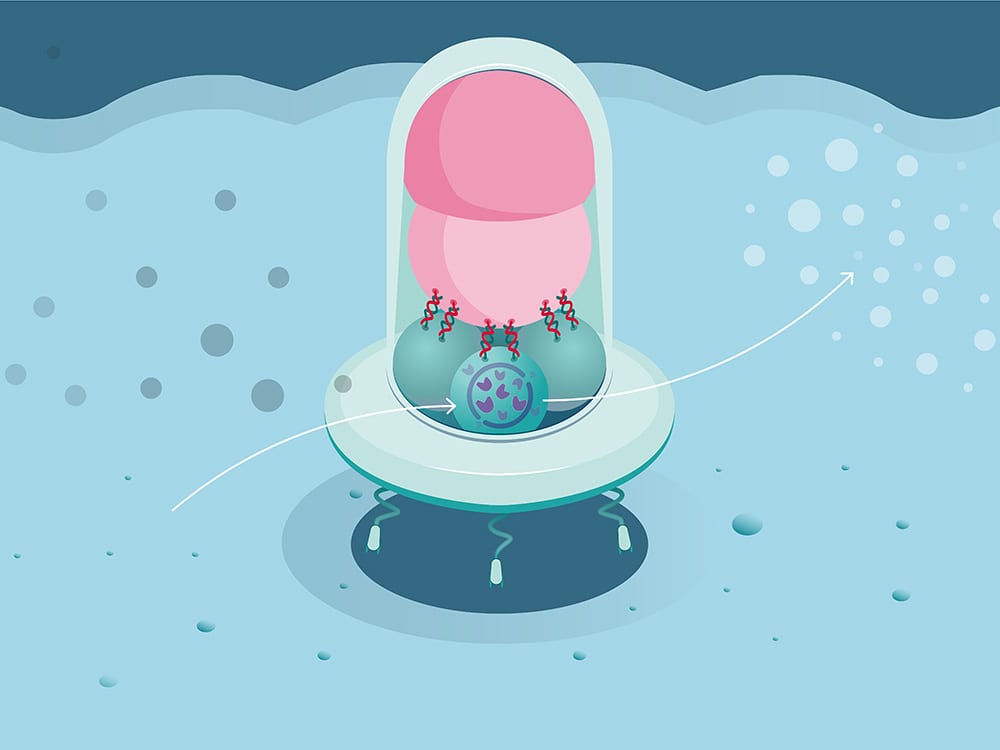
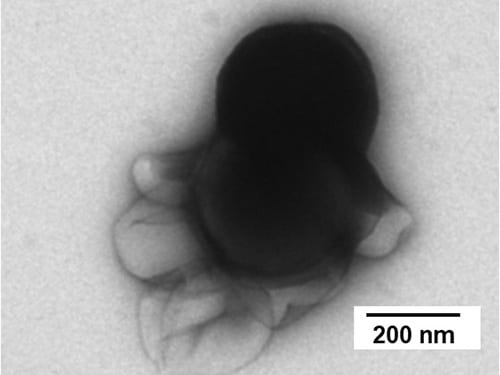
The design resembles a multistage rocket. One module is a magnetic propulsion unit that moves the nanorobot. The second is a payload capsule that carries therapeutic agents or enzymes to a target location and protects them on the way.
The capsule holds four polymer vesicles, each loaded with enzymes. Palivan's group developed this kind of vesicle in earlier work. Molecules from the surroundings enter a vesicle through pores, the enzymes process them, and the products leave into the environment. Depending on the design, the vesicles in the capsule can also be opened selectively, for instance to release bioactive compounds.
The two modules are held together by complementary DNA strands, which the team compares to a Velcro fastener. The strands on each module pair up, so the propulsion unit and the payload capsule assemble themselves in a programmable way and stay coupled. The capsule also carries additional biomolecules that help it dock onto specific cells or materials.
Unlike larger robots, these machines have no electronics, computer chips or software. They are built from biomolecules and nanoparticles.

Tests on HeLa cells
The team tested docking on HeLa cells, a human cancer cell line. They loaded the nanorobots with fluorescent molecules and watched under a microscope. The nanorobots accumulated on the surface of the cells.
In a second test, the nanorobots carried the enzymes needed to produce an anticancer drug. They made the drug, and the viability of the HeLa cells fell to 16 percent within 72 hours. Dr. Voichita Mihali, first author of the study, says the drug can act locally and with concentration if the nanorobot targets it to the cancer cells.
The system is not limited to medicine. The nanorobot can attach to specific surfaces and run enzymatic reactions there, converting molecules from its surroundings into a desired product. Because the propulsion module is magnetic, the nanorobots can be retrieved after a task and used again. The researchers also separated the two modules, refilled the payload capsules and recombined them with the propulsion modules.
Palivan says earlier nanorobots were often designed for a single task, while this modular system can be adapted to different applications. The team names medicine, industry and environmental technology as possible fields. Catalysis is one example outside medicine where retrieval and reuse could matter. According to the researchers, the system can be adapted to other domains by changing the payload capsule.
The work was carried out within the National Center of Competence in Research – Molecular Systems Engineering and the Swiss Nanoscience Institute. The Basel team worked with researchers from Heidelberg University. The paper is titled Multiplex Modular Nanorobotic Systems with Catalytic Activity under Magnetic Navigation.
What the result means, and what it does not
The main contribution is architectural. Many nanorobots are built around one job, so a change of task means a new design. Here the propulsion, the payload and the docking function are separate parts. Changing the payload capsule changes the job, and the DNA coupling means the parts can be taken apart and rebuilt. The refilling and recombining experiment is the strongest evidence for this, because it shows the modules can be separated and reassembled after use.
The drug result shows something different from simple delivery. The nanorobots did not carry a finished drug to the cells. They carried enzymes that made the drug where the robots had docked. That keeps the active compound at the cell surface, which is the point of the local effect Mihali describes. It also fits the payload design, since the vesicle pores let raw molecules in and let products out.
The evidence has limits. Every biological result reported here comes from one human cancer cell line grown in the lab. The source does not report tests in animals or in the body, and Palivan's team describes use in humans as a long-term goal. The 16 percent viability figure is for HeLa cells over 72 hours. The source does not say how selective the nanorobots are between cancer cells and healthy cells, so that remains unshown.
Several practical questions are also open. The source does not describe how the magnetic propulsion module performs when steering through tissue, or how the DNA coupling holds up in biological fluids over time. It does not say how the nanorobots would be produced in quantity. Retrieval and reuse are demonstrated as a property of the magnetic module, and they make the most immediate case for non-medical uses such as catalysis, where there are fewer biological constraints.
As a comparison, the source says only that this system offers more functional flexibility than many existing ones. It gives no head-to-head data, so that claim rests on the design rather than on measured performance against other nanorobots. The next results to watch are tests with different payloads in the same platform, since the modular claim depends on swapping capsules without redesigning the rest, and any move beyond cell culture.